For Us, not To Us

I’m in the process of finally doing some deep personal study of Revelation (I’ve been putting this off for some reason) and so I was reading that portion of Luke Timothy Johnson’s intro The Writings of the New Testament: An Interpretation (Third ed.; Minneapolis: Fortress, 2010). One good thing about scholars is that not only can they teach you things you don’t know but they can also help you say things you would like to say.

Johnson says this:

“The conviction that God’s Word speaks directly to every age has not been accompanied by the appreciation that it does so as mediated through its initial historical expression. The contemporary significance of any NT writing does not derive from the fact that it was written expressly for our age but from the conviction that a truth spoken to the first age of Christians can and does remain a truth for every age of believers” (508).

I would like to say that, too.

I don’t think there’s anything more important–and perhaps anything more lacking–in properly interpreting Scripture than this. My entire higher education has been in biblical studies, so I have been trained to think about the original historical contexts of the biblical writings without even thinking about it. This isn’t something that should be true of only people with the same sort of education as me, however.

Many readers without any formal education on how to interpret ancient texts simply don’t know that what is needed is a close look at who wrote, to whom, when, why, where, etc. Instead interpreting a word or idea first through the lens of whatever information we have about its original author and reader, the natural move for many is to simply receive that word or idea into their own context. It’s like an American going to England and being asked if she wants a biscuit. She says yes, taking the word “biscuit” directly into her own American context (which is a foreign context in England) and she receives something almost totally different from what she expected to receive. What she actually receives she has a word for, but it comes from her own, American, foreign context; to her, it is a “cookie.”

It is this practice of not considering (or being unaware) of the differences between one’s own context and the context from which a text comes that has led to the myriad of strange conclusions as to what Revelation, for instance, is actually talking about. It is reading a text as if its words apply directly to your own linguistic, cultural, historical, situation. 

And It’s even trickier for readers, not just of any ancient text, but those who consult the Bible as an authoritative revelation of God. We don’t even want to think about the idea that the Bible was not written to us. Of course it was! It’s what we memorize, meditate over, pray with, it’s what informs us, encourages us, disciplines us, guides us. The Bible was written to us! Stop being heretical, Nathan.

Well, no, I actually don’t think that’s the best way to think about it. I think the best way to think about it is as if the Bible was written for us (and that’s not heretical so you can relax). Paul’s letter to Titus was written to, wait for it, Titus. In God’s grand scheme, it was written for us, but Paul most likely never envisioned that he was also writing to 21st-century believers. And we take Paul most seriously, and we treat the Bible most respectfully, when we listen first to Paul writing to Titus. And only as a second order to that, what it means for us.

And it’s the same way with the entire rest of the Bible.

Even in a portion of Scripture regarded most highly by Christians like the Sermon on the Mount for how it illustrates the proper Christian ethical life—we cannot say that it was composed and delivered to the church. Because, it was not written to be immediately understood and applied by Christian believers made mostly of Gentiles who worship the risen and ascended Lord. It was written to be immediately understood and applied by first-century Palestinian Jews still waiting for a Messiah and still curious about how and when the future age of peace and justice will be established.

What was true for those ancient Jews, in some ways is true for us, but that truth is not directly communicated to us. We have to engage in interpretation, in the principled system of inquiry known as hermeneutics, i.e., properly interpreting and applying the Bible. We have to respect context, both our own, and foreign ones. To do so is to honor the way that God has chosen to make himself known–through history, through events, through conversation, through argument, through language, culture, irony, suspense, characters, rhetoric, and so on. And not to us, but for us.


Why You Don’t Have to Believe Your Intuitions Are the Holy Spirit

This is the title of the second chapter of Phillip Cary’s book Good News for Ancient Christians, which I’ve been discussing chapter by chapter.

“Or, How the Spirit Shapes Our Hearts” Is the chapter’s subtitle.

Cary relates what he says here to the previous chapter about hearing God’s voice in your heart, by pointing out that another way people tend to think of God speaking them is through intuition. This type of intuition he defines as that moment when you “just know something” even though you may not know how you know it (19).

It is this being unable to explain the origin or source of a belief that leads many Christians to conclude that what they’re sensing is the voice of the Holy Spirit (19).

However natural this tendency may be (I know I’ve done it several times), Cary points out the fallibility of constructing some sort of doctrine on this just by reminding us that sometimes our intuitions are wrong (20-21).

And Cary pinpoints what it is about these intuitions that lead us to attribute them to God, to outside ourselves. And it has to do with vocabulary. I was on the way to Atlanta once and listened to this long program on the radio about how crucial vocabulary is not for just expressing our experiences but actually experiencing those experiences themselves. Cary says that it is the lack of vocabulary to describe a feeling or thought that makes it feel like, i.e., it is experienced as, it is coming from God (23). I think he’s on to something. Because when we don’t know how to explain something, or we don’t have the word for it, it’s not that we just experience it as not having the words to describe but that we experience as it as something coming from outside of us, in a sense. And the most natural place for Christians to attribute something coming from outside themselves but within their own minds, is God.

When seen as a lack of vocabulary to explain the intuition, the “unexplainability” actually becomes explainable. There are several reasons, as Cary points out, we have the intuitions we have (23-24).

The damage that is done? “… one of the deepest errors of the new evangelical theology. It teaches people to identify their intuitions as the Spirit speaking, without teaching them the virtues that are the real fruit of the Spirit working within. It tries to find the voice of God in the intuitions of the unsanctified heart” (32).

In light of this, Cary offers the same sort of advice he offered in the last chapter about hearing God’s voice in your heart. Our focus should not be on the revelation from inside but from outside. “It may seem surprising,” he says, “that we should listen for the Spirit by listening to God’s word outside us. But that’s how the Bible talks about it. That’s because the Bible does not have the notion that’s so common in the modern world of looking inside yourself to find the spiritual help you need” (33).

But the Spirit does work in us, doesn’t he?? Well, yes. But, inquiring minds want an answer to this question: “How do we know the Spirit is working in us?” Especially, if Cary is on to something, that we should not be searching for an inner voice as often as we tend to do as contemporary western evangelicals. Cary says this is a particularly modern obsession, which results more in searching our hearts than in searching the Scriptures (34).

Not sure what else to say about this chapter. I think it’s a good illustration of the book’s major weakness, namely that it would’ve been well-served by some editing primarily in the form of cutting. This would’ve worked well as another part of the previous chapter. There’s a good deal of fluff in this chapter that I moved right over. However, it gets better. Cary still has some worthwhile lessons to teach. Picks up big time with his excellent chapter “Why You Don’t Have to ‘Let God Take Control” which we’ll discuss next time.

? American=Christian ? Christian=American ?

It becomes clear to me especially when we elect our government officials that for many Americans, being Christian and being American are two sides of the same coin.

I was consulting the great Gordon D. Fee’s Philippians commentary a couple of days ago [Paul’s Letter to the Philippians. NICNT. (Grand Rapids: Eerdmans, 1995.)]. He makes this observation while discussing 3:4b-6:

“A passage like this one, especially in light of Paul’s language of renunciation in vv. 7-8, should perhaps call into question … the confusion of Christian faith with pride in nation. … Confusion of being Christian with being a member of a given nation has a long history in the church; it is one of the pernicious bequests of the conversion of Constantine, which plagues not only the officially ‘Christian’ states, but perhaps even more insidiously a country like the United States, where the American flag often holds pride of place in Christian sanctuaries and where patriotic holidays are sometimes more significant days in the American church calendar” (310).

I’ve aware of circles of American Christians where the 4th of July and other national holidays are given much more attention than, say, Epiphany, or Pentecost. Admittedly many of these church groups have chosen not to follow the traditional church calendar, but they do make up for it with American holidays.

Many adhere to a system of thought which intertwines their convictions as Americans and their convictions as Christians to the point where they are indistinguishable, and it’s probably safe to say that both sets of convictions are warped as a result.

So I’m advocating keeping our political and religious convictions entirely distinct from one another? Well, yes and no. Yes in the sense that we should be able to recognize that we believe certain things because we are Christians. No in the sense that I believe that a proper Christian faith isn’t compartmentalized, as if we can act and think and feel as Christians in some aspects of our lives but not all of them. Faith in Christ is holistic.

So I perceive an abiding tension when I think about how political and religious beliefs should go together. This blog will not often get this political, but I tend to vote for Republican candidates. And this tension between politics and religion can be seen in how I responded to Ron Paul’s comment in a recent debate. When the candidates were asked how their religious convictions would affect their decisions in the Presidential office, Paul responded “They wouldn’t.”

My most immediate response was negative (I actually like most things Paul says), because of how I see the Christian faith (which Paul claims as well) as ideally holistic, so that one couldn’t claim a clean divorce between what one thinks and feels as a Christian and thinks and feels as a politician. But then again, Paul doesn’t appear to make the mistake that to be an American is to be a Christian, and to be a Christian is to be an American.

Contrast Paul’s response to this debate question with some recent remarks by President Obama during the National Prayer Breakfast. The President was forthright in his admission that his Christian faith clearly and directly influences his political decisions, citing Luke 12:48 for justification of his proposal to raise taxes for the wealthy in order to provide for the less wealthy.

Aside from the fact that this is a poor application of this Scripture (coming back to this in a moment), at first my response is positive to Obama’s position that one’s principles cannot be cleanly divided between the religious and the political. But my response is also negative, because Obama inappropriately fuses his religious beliefs to his political ideology without an observable measure of care. I’m very confident that the President doesn’t think this way, but it gives the impression that he is like those who think that to be American is to be Christian. He will use the Bible to justify his policy to basically force people to help the poor, but would he tolerate others using the Bible to define what marriage is for all Americans, Christian or not?

Back to the fact that the President’s quotation of Luke 12:48 is not sound support for raising taxes for the rich to help the poor. Nowhere in Scripture, at least in what I can see, is there a basis for providing for the poor through government force. As a Christian, I agree with Obama that the poor should be provided for by those who have the resources to provide for them. Our difference is that I am American but I recognize that this is something different from being a Christian. It is not the place of government to take from all people, Christian or not, to provide for others, based on a Christian principle. That Obama seems to think so implies that he sees the pockets of all Americans as his pool of resources from which to draw from to provide for those who lack. This does not work. Giving is an act of love. Love is voluntary and cannot be coerced. A voluntary deed is not voluntary when it is required. The government functions through requirement. There’s no voluntary tax that I know of.

So I don’t think it works to take a political stance based explicitly on a Christian principle alone, but then again I can’t say that if I were to take a political stance based not only on my Christian principles that it was not affected by my Christian principles. To be an American is not to be Christian and to be Christian is not to be American, but I am an American Christian.

Tensions remain.

I have mostly rambled and I don’t know what else to say. Good thing it costs me absolutely nothing to publish this on a blog.

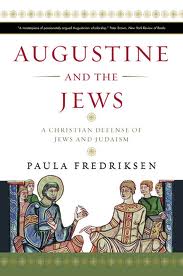
Augustine and the Jews

In my discussions of Good News for Anxious Christians, we are looking at a book meant to offer an immediately practical benefit for believers. I think it would be good for my brain, and for the tone of the blog, if I also kept a running discussion with a book of a more academic nature. Because, you know, I’m all about sophistication.

(There will be no method to coordinate which books I’m discussing at the same time nor to explicitly draw any connection of any sort between them. This is also good for my brain. Or at least it feels good.)

Well, the academic book I’m reading now that I’ve decided to discuss (I read many books at a time)  is Paula Fredriksen’s Augustine and the Jews: A Christian Defense of Jews and Judaism (New Haven: Yale University Press, 2010). I’ve anticipated reading this book for about a year now, and there’s several reasons why I think it will be such an interesting read for me.

One is that I’m a big fan of the author. Fredriksen is the William Goodwin Aurelio Professor of the Appreciation of Scripture Emerita at Boston University. I certainly have significant disagreements with her positions on some topics, but her books, articles, and lectures (at least the ones I have gained access to) continue to provide me with a valuable model for how to engage in respectable scholarship of the Bible and early Christianity. She displays an insatiable interest, brutal honesty, lucid reasoning, fresh readings of the text (albeit informed by the work of previous scholars), a great degree of familiarity with historical/cultural contexts–and does not lose track of the larger and most important question of why we even try to understand early Christianity in the first place.

However, her answer to this question would probably differ from mine. Fredriksen is a Jewish convert from Roman Catholicism. Though I don’t know for sure if this comes as a direct correlation, her most insightful contributions to our knowledge of the New Testament and early Christianity stem from her niche as serving as a sort of conscience for scholars by keeping them on track when they’ve veered off by either misunderstanding or mischaracterizing ancient Judaism.

This is the other reason why I’m excited to learn from this book. The academy has been getting better at this for the past several decades, but the church (even its leaders) still largely lags behind at gaining a proper grasp of ancient Judaism (and modern Judaism, for that matter). I know its title conceals this, but the book actually has a good deal to teach us about ancient Judaism and Christianity and one of its practical outworkings, Jewish-Christian relations.

Augustine and the Jews. It was mainly Fredriksen’s observations of Augustine that spurred my recent interest in him and in turn helped me realize how much the church fathers have to offer us all these centuries later. This book’s potential for teaching us a few things about Augustine actually looks promising.

Augustine. Jews. I can already tell though, that this 380 page book has much more in it than just the bare facts on these two topics. Fredriksen is distinguished by the fact that she can claim expertise in what are essentially two fields: New Testament, and early Christianity through the conversion of Constantine in the 4th century. This book is probably going to be a wide representation of her learning, and I could tell from a glance at the table of contents that she establishes her basic case about Augustine and his value to the Jews with a broad scope. She also wraps up her prologue with the statement that she wanted to recount decades of research “in one sweeping story” (xxiii). Prepare to learn.

As a side note, Fredriksen was also impressively nice to me when I took the opportunity to introduce myself to her at SBL conference about a year ago as a lowly master’s student. Kindness is always a good thing.

Let’s take a look at the prologue (from the Greek preposition pro [before] and the noun logos [word, saying, matter]) to complete this post. Right at the get-go Fredriksen lays out the main point of the book. During the 12th century Crusades, Rabbi Ephraim of Bonn records the contribution of Bernard of Clairvaux, in his eyes a “decent” priest who allowed Christians to battle Muslims, but stated that “‘whoever touches a Jew to take his life is like one who harms Jesus himself …, for in the book of Psalms if is written of them, “Slay them not, lest my people forget.” All the Gentiles regarded this priests as one of their saints. … When our enemies heard his words, many of them ceased plotting to kill us.'”

This instruction from Bernard however, originates not from his own appropriation of this portion of Psalm 59 but came about 7 centuries sooner in the work of Augustine, Bishop of Hippo (xi). In Augustine’s eyes, the Jews were to be respected because their religious practices were authored by the same God the Christians claimed as Father. Not only that, but they aid Christians by serving as witnesses that they have not made up the prophecies concerning Christ. This is why, in Augustine’s understanding, we have the Psalter’s prophecy: “Slay them not, lest they forget your law; scatter them by your might” (City of God 18.46) (xii).

Herein lies Fredriksen’s big conclusion: that this legacy of Augustine’s positive view of the Jews was passed down to the Crusades and helped to prevent violence against Jews at the hands of Christians. “Augustine and the Jews,” Fredriksen writes, “tells the story of how Augustine came to conceive this unique teaching, which was original to him” (xii).

Fredriksen then provides a paragraph about Augustine, and you can hear how much she admires him. After calling his works “brilliant and original,” she says “Augustine’s writing is so vivid, his intellectual energy so fierce, the force of his personality so present, that we can practically hear him thinking” (xiii).

First things first, though. Before we talk about how Augustine helped protect Jewish lives centuries after he lived, we must consider the question of how did the relationship between Christians and Jews become so hostile in the first place? (xiii)

The answer is complicated. For one thing, much of Christianity, though it would quickly become dominated by Gentiles, is “quintessentially Jewish,” such as in its ideas of resurrection of the body, divine judgment, and a messianic age (xiii).

Early Christianity was essentially a Jewish movement, and so this rough relationship seems to begin in the second century, when Christianity and Judaism became distinct movements. In-house arguments between Jews over a potential Messiah then became arguments against Judaism itself (xiv). Unfortunately, this adversus Iudaeos or contra Iudeaos position took considerable root in the form of Christianity’s teachings “against the Jews” (xv).

Fredriksen’s goal is to provide us with a grasp of the history and role of this anti-Jewish rhetoric in Augustine’s time so that we can appreciate with greater clarity how he challenged this tradition. This is why her book covers the expanse of time from Alexander the Great in the 4th century B.C. to the Christian empire of the 5th century A.D.

Part I, “The Legacy of Alexander,” describes the background for approaching the interaction of pagans, Jews, and Christians in the Greco-Roman world (xviii). Part II, “The Prodigal Son,” deals with the context of Augustine’s teachings on Jews, i.e., his own intellectual and spiritual development. Part III, “The God of Israel,” draws the threads together to observe how Augustine arrived at his noteworthy view of Judaism (xix-xx).

The final section of her prologue provides some other preliminary remarks before she begins. One, and I know she takes this position based on her other works, is that she views orthodox Christianity as just one kind of Christianity that won out in the end and became the standard against which all other different forms of Christianity were seen as heretical (xxi). This view is not at all uncommon among scholars, though it is found much more in the thoughts of non-Christian scholars. This reveals my bias when I say I don’t take this position. I don’t think that orthodox Christianity was just as valid as any other group that claimed the name “Christian”; I think that the Christianity that became known as “orthodox” more or less corresponds most directly with the theological and ecclesiastical conclusions we can draw from the records we have from those who experienced Jesus. And, I might add, it is “orthodox” Christianity which in my view coheres with 1st century Judaism and the story of Israel rather than the alternatives such as gnostic Christianity.

But that’s a side note. I think this is going to be great. Next post we begin to look at Part I, “The Legacy of Alexander.”

“Why You Don’t Have to Hear God’s Voice in Your Heart”

This is the title of the first chapter of Phillip Cary’s book Good News for Ancient Christians, introduced in the previous post.

“Or, How God Really Speaks Today” Is the chapter’s subtitle.
Cary discusses a comment in one of his student’s papers. The problem with revelation, this comment said, was that you can’t tell if it’s the voice of God. How do you know the voice you hear is the voice of God? One problem is that this student didn’t think of revelation in terms of Scripture but in terms of something resembling an audible voice arising within one’s heart or mind (1).

Cary’s response to this student: “I have good news for you: the voices in your heart are all your own. So you don’t have to get all anxious about figuring out which one of your voices is God. None of them is. The revelation of God comes in another way, through the word of God in the Bible, and this is something you can find outside your heart” (2).

I know I wouldn’t have answered this student in quite the same way; for one, I couldn’t tell someone else that a voice they hear is not the voice of God without allowing that it could possibly have been God’s. But I agree with his major point. God does not ordinarily speak to us through what we would call a voice, i.e., what we hear when we hear another person talk out loud. You might say, well what about all the times in the Bible (particularly in the Old Testament) that God does speak to people in what we have every indication to believe is some sort of voice? In most cases, however, the text simply says that God said to — and there are typically no details about its audibility or any question/confusion whether it was one’s own thoughts or the voice of God. However God spoke in those instances, it is certainly different in some way than how is he said to speak in people’s hearts today.

To be honest, we all know that this is a problem. I would bet most of us at least have heard some one describe what God has said to them, and we are quite confident based on our understanding of that person or our understanding of God, or both, that God did not actually tell them that. (Cary gives the example of guys at his college telling girls “I think God is telling us he wants us to get together” [5]).

But how do we address this? Do we know for sure that God didn’t talk to this person directly? In most cases, we can’t know for sure, the one exception being when God is reported to have said something that is known to be an error or even a lie. Something to think about.

Anyway, as Cary later asserts, listening for God’s voice in the heart has only recently (new evangelical theology) displaced Scripture as the most important way God makes himself known (2). (He also admits that this way of hearing God speak has become so dominant in American evangelicalism that his students are not aware that it was ever any different [4]). Again, even in the groups I’ve been a part of in which hearing God’s voice in your heart was held in high regard, I’m not sure it eclipsed Scripture. But the point still stands. The canon of Holy Scripture is the solid, reliable revelatory source of God’s nature and his will. It is what has historical grounding as providing the authoritative word on these matters–not what an individual thinks God is telling them in their hearts.

So, just as Scripture is external and hearing God’s voice is internal, Scripture is somewhat more objective whereas hearing a voice is much more subjective. God speaks to us a person, i.e., some one else other than us. “And you can’t listen to another person just by hearing what’s in your heart” (3). Acknowledging the clear biblical teaching of the indwelling of Christ and the Holy Spirit, Cary responds, on the basis of texts like Romans 10:15, 17, “Christ gets into our hearts precisely as we put our faith in the word of Christ that we hear preached to us. He is a person who is inside us because we find him outside us. That’s how it always goes with persons” (3).

Another problem Cary points out is that sometimes we fail to take our own voice seriously. He gives the example of a girl who is crazy about a guy but at the same time is uneasy about him and about the way he treats her. The voice that says “I don’t feel right about this” she attributes to God, because “she’s never thought of her own voice as something worth listening to.” She has to label this wise thought the voice of God because she can’t take it seriously any other way (5). If it’s a wise thought, in her thinking, it must be God’s. This “new evangelical theology” which puts a priority on hearing an actual voice from God “undermines her sense of morality, her responsibility, and her adulthood, not to mention her self-knowledge” (6).

This is why, Cary, concludes that the new practice of “hearing God speak” “is doubly bad for us. By trying to identify which voice in our hearts is God’s, we not only misidentify God, we fail to know ourselves for who we really are” (8).

If this idea is not biblically based and is a very recent development in church history, then where did it come from? Well, wherever it came from, Cary points out that none of us came up with it on our own; it is something that we are taught: “We are told to listen to God in our hearts and make it an ongoing part of our lives. And we are made to feel guilty if we don’t put it into practice” (10). People wonder, If I don’t hear God’s voice, do I not really have a relationship with God? (11)

“The good news about self-knowledge is that it’s ok for your feelings and thoughts to be your own, not to be the voice of God. For the good news about God is that he makes himself known the way a real person does, by speaking to us from outside our hearts” (14).

Speaking about the prophets Cary says, they never talk about hearing God in their hearts. They talk about dreams and visions, but they “know nothing of the practice we have been taught today where you try to quiet yourself and hear God’s voice in your heart” (16).  “The word of God still comes out of human mouths and resounds in the ears and hearts of his people. That’s where you go to hear God–you dwell in the community of his people, because that is where his word is” (14).

Though he doesn’t pursue it, this is where Cary deals a searing blow to the flaw of individualism in contemporary Christianity. Reflecting on the church’s activity of praying and singing the Scriptures, Cary says “That’s how it works, because the place to look for God’s word is not in your heart but in the gathering of God’s people in worship, prayer, preaching, and teaching” (15). And he provides examples of Paul’s admonitions to second-person plurals as indications of this (e.g., Col 3:16; Eph 5:18). One pitfall of modern English translations of Greek is that Greek uses different forms for “you” as it refers to an individual and “you” as it refers to two or more people. With the Bible in the hands of individual readers reading to themselves, an English “you” which actually corresponds to a Greek “ya’ll” leads to the misconception that the epistle writer is addressing you and only you.

Now the epistle writers do use the single “you” at times, but even when he does so, an individual is never addressed in such a way that what is said is irrelevant to the group. I’m sure at some point I’ll write more on this issue, but as personal is it is, Christianity is not private. Other religious options may allow for you to engage them as what you belief in your own privacy, and that’s ok; but Christianity does not fit into that mold without being warped beyond recognition.

Indeed, as Cary asserts, the Spirit “does not come to give people private instructions.” That was never the purpose of prophecy, which was instead for the sake of the community of God’s people (16). So what is the best place to hear God’s “voice”? “… in a gathered congregation of the Body of Christ, where he is present to teach, comfort, warn, and guide all who believe” (16).

For Cary, of course God speaks today. But we must correct the common view that the only, or even primary, way God speaks today is in the privacy of individual hearts. Cary makes the point that many haven’t been taught to hear the gospel as God’s word. Once people are saved (most of the time thinking that the main thing they have done is avoid a negative post-death eternity), “they think the gospel of Christ has nothing more to say to them about their Christian lives” (17).

Also, of course, God can speak in a voice to an individual heart, but Cary wishes to face the question of what God actually does rather than actually what he can do (17).

This chapter features a clever conclusion paragraph about the Lord’s face being a human face and his voice being a human voice. This is what makes it “okay that our voices, too, are our own human voices–even the voices of our heart. They don’t have to be God’s voice to be worth listening to, or even to speak the word of God” (18). This is a fine point. From the incarnation, to eating and drinking and weeping and rebuking, to dying and rising and ascending, Jesus is God’s prime illustration of just how much he meant it when he created us and called it good.

So we should listen to our hearts. I agree with that. But the main criticism I have of Cary’s chapter is that he does not discuss the danger that is associated with doing so. As much as we should listen to our hearts, we should follow the biblical patten and speak to our hearts. The heart basically a way of talking about the entire inner person, emotions, thoughts, all of it. And our inner person (like our outer person) is messed up. Jeremiah says “The heart is devious above all else” (17:9). Yes, listen to your heart. Don’t ignore yourself. But as you do, pray “Create in me a clean heart, O God” (Psalm 51:10). And Cary makes a good point: to hear God we turn away from our hearts (8).

As one would perhaps expect since Cary is more of a philosopher/theologian, the biblical texts aren’t consulted to the extent that they could be and probably should be if we are to discuss the biblical validity of these ideas. This is the book’s major weakness. Still, even if Cary approaches these ideas from a primary philosophical/theological point of view, his arguments should be acknowledged and dealt with according to the testimony of Scripture (even if we have to do much of that biblical searching on our own). And, as I’ve said, I don’t think we should dismiss the possibility of God speaking to us through a voice, but there is much value in recognizing that if he does speak through a voice, it’s likely in the form of the words of your neighbor, or the testimony of Scripture, or the message of a work of art, or whatever. God is that big. You don’t have hear God’s voice in your heart.

Next chapter:  “Why You Don’t Have to Believe Your Intuitions Are the Holy Spirit”
Good News for Anxious Christians – Intro

There’s a lot of things that Christians do assuming that we have to do them as genuine believers. But what are the bases for these things? What are they grounded in? Are they grounded in anything authoritative such as the Scriptures?Image

Phillip Cary (Ph.D., Yale University) is professor of philosophy at Eastern University and scholar-in-residence at the Templeton Honors College. He has published his critical study of ten things that makes many Christians are concerned to do, some even anxious about–but that you don’t have to do. 

It’s called Good News for Anxious Christians: 10 Practical Things You Don’t Have to Do (Grand Rapids: Brazos Press, 2010).

Of course, I don’t agree with every move Cary makes here, but many of his moves are worth every contemporary Christian taking a look at.

Have you been worried because you’ve never heard God’s voice in your heart?

How many times have you heard “let God take control”?

Is finding God’s will for your life at the top of your agenda?

These are just three of the things that Cary shows Christians do not have to do, in spite of how much it is taken for granted that we do have to do them.

Cary attributes these ten misunderstandings to what he terms “the new evangelical theology” (ix). That’s a pretty broad term that may not actually be the most ideal, but what it does point out is that these mistaken notions are found among evangelical types for the most part, and they are new. You won’t find church figures through the centuries much concerned about these issues; they afflict a small sphere within the historical and geographical expanse of Christianity. And, according to Cary, “they get in the way of believing the gospel” (x).

In a paragraph in which he reminds us that the church is constantly to be in the process of reform for the sake of truth, Cary expresses from the outset that he is “trying to preach the gospel of Jesus Christ to Christians. I’d like us all to be free to rely on the gospel rather than put our trust in a bunch of supposedly ‘practical’ ideas that are actually doing us harm” (ix).

Cary’s ultimate quest: “to convince you … that these ideas are not really biblical, despite the fact that they are often dressed up in biblical language” (x).

Cary has some very important things to show us. It’s time to get back on track with some of the ways we live our faith, and ditch what is unnecessary and even harmful to it in the first place.

Discussion of chapter one coming soon.


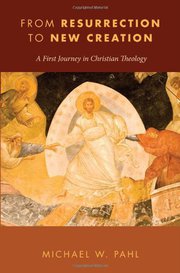
From Resurrection to New Creation by Michael W. Pahl

Recycling from Facebook again. I think this is the only book review that I’ve voluntarily completed. I’m such a fan of this little book and strongly recommend it for a wide readership. Originally published as a Facebook note on February 9, 2011.


Michael W. Pahl (Ph.D. in theology from University of Birmingham), pastor at Lendrum Mennonite Brethren Church in Edmonton, Alberta has written the best little introduction to Christian theology that I have seen.  I picked up his From Resurrection to New Creation: A First Journey in Christian Theology (Eugene: Cascade Books, 2010) at SBL in Atlanta this past November, and have read pieces of it while I’ve been home since then.  In only 100 pages (yes, it’s nearly a booklet), I think he offers a much more vivid, relevant, and holistic explanation of the Christian faith than any 1000+ page systematic theology.

Most of my enthusiasm for this succinct book, therefore, is the way it approaches Christian theology through story, basically recounting the overarching narrative of God’s redemption and renewal of the world by focusing on seven topics which are the names of the book’s seven chapters: Resurrection, Crucifixion, Son, Gospel, Father, Spirit, Creation As is evident from the title, Pahl focuses on what has always been the center of the Christian message but what has too often been ignored, especially in the past few centuries of evangelicalism with its narrow focus on the good news being all about God saving the individual from sin.  Christianity is immensely bigger than individual salvation from sin though it definitely includes it, and it first and foremost both satisfies the deep human desire to know the larger story and to play a part in it.  Though for a number of reasons people have so often reduced Christianity to a list of doctrines to believe in order to “be a Christian,” I don’t believe that is really what people want, need, and more importantly, what God has provided for them.  Right doctrine is certainly a part of the process, but Pahl simply and elegantly demonstrates how Christianity is at its foremost about the Story.

I doubt one would find a better book to use in small groups or in classes for a basic primer on Christian theology.  Pahl begins and ends each chapter with some discussion questions, the materal is easy to read, and he offers both scriptural references and book lists for further reading at the end of each chapter.  Pahl keeps his writing simple, and (as he emphasizes toward the end of the book) what he unfolds is the core of true, biblical Christianity as it is (or at least should be) observed by Catholics, Orthodox, and Protestants.  In this way, the book is a fine measuring rod for determining what actually constitutes the Christian church; Pahl does not discuss marginal issues that divide Christians–he only shows what unites us all.  As a result, plenty of groups that like to identify themselves as Christians, such as Mormons, Jehovah’s Witnesses, and Christian Scientists will find little to agree with in this book.  This is “mere Christianity” wonderfully explained.  And I also I think it’s wonderful, I’ll add, that this comes from the desk of a pastor, not a full-time academic.

Here’s some highlights:

“the New Testament authors were themselves ‘doing theology’ as they explored the new terrain laid out before them in light of Jesus’ resurrection.  Thus, the Trinity and other distinctive Christian doctrines and practices are, in a real sense, first a matter of history before they are a dogma of theology” (x).

“Attempts to ‘prove’ Jesus’ resurrection historically, to find analagous events of resuscitations and visions, to determine a historical cause for this event, are not only wrongheaded historically, they are wrongheaded theologically” (11).

“The stories of creation and exodus reverberate in the New Testament descriptions of Jesus’ resurrection, pointing back to the motifs of transcendence in the foundational Jewish descriptions of God: God’s power, holiness, and sovereignty over all creation” (60).

“How do even know God exists?  And if God does exist, how can we know God?  That is, how might we discern God’s activity in the world in order to understand who God is?  The early Christian answer to these sorts of questions was simple, yet profound: look to the crucified and resurrected Jesus … Of course, this answer is already a response of faith; that is, it will not convince someone of the existence of God who is not already predisposed to that belief, particularly in view of the reality discussed earlier that one cannot prove the resurrection of Jesus either by critical history or analytical logic.  Nevertheless, this is exactly what is called for in the Christian proclamation of the crucified and resurrected Jesus: a genuine response of faith and trust, not the false security of a claim to irrefutable knowledge ” (67, 69).

“So we should not expect to find God only ‘in the gaps’ of our knowledge of the natural world or human history.  God is as much present in the scientifically and historically explainable as he is in that which has not yet been explained.  Nor should we expect to see God only in the ‘miraculous,’ or in the triumphs of life.  God is as much present in the mundane and in life’s tragedies as he is in those experiences which are typically seen as the more likely demonstration of divine activity” (70).

“Indeed, the resurrection of the crucified Jesus is the ground and center of all truly Christian thought and action, both the source and the focus of all belief and behavior that can be called authentically Christian.  All disctinctively Christian theology and practice should grow out of the reality–and be centered on the reality–that the crucified Jesus has been resurrected from the dead” (102).

“And the gates of hell will not prevail against it”? R.T. France on Matthew 16:18

I posted this in a Facebook note (remember those?) on September 25, 2011. I’ve already run out of things to say, so I’m recycling old stuff. I just love blogging.


This portion of Jesus’ speech in Matthew’s Gospel after he has been recognized as Messiah is often quoted: ” I will build my church, and the gates of hell will not prevail against it.” What usually goes along with this is the explanation that this is a powerful image because gates don’t go out against anything, so the picture is of the church “storming the gates of hell,” or something like that. This gets passed around quite a bit but I’m not sure if anyone has actually checked this idea out to see if it actually holds any weight. I don’t have the time now to do any sort of research on this, but I did check my commentary The Gospel of Matthew (Grand Rapids: Eerdmans, 2007) by R.T. France, a wonderful intepreter of Matthew, and this is what he has to say:

The gates of Hades [France is simply giving you the Greek word here, which is Hades. To translate it “hell” is an interpretive move.] is a metaphor for death, which here contrasts strikingly with the phrase ‘the living God’ in v. 16. In the OT the ‘gates of death’ describes the place to which dead people go (Job 38:17; Pss 9:13; 107:18), and in Isa 38:10 the phrase ‘the gates of Sheol’ is used in the same way. ‘Hades’ is the NT equivalent of Sheol … [The mistake is repeatedly made to associate ‘Sheol’ with ‘hell.’ The OT does not know of ‘hell.’] The ‘gates’ thus represent the imprisoning power of death: death will not be able to imprison and hold the church. Still less does it support the romantic imagery, sometimes derived from the traditional butincorrect translation of ‘gates of hell,’ of the church as a victorious army storming the citadel of the devil. The imagery is rather of death being unable to swallow up the new community which Jesus is building. It will never be destroyed. (624-25)

“The opposite of sin is not virtue but faith.”

I preached a sermon on January 8th of this year entitled “Faith in Romans.” I moved quickly through the letter, pausing at certain places to comment on what Paul reveals about faith in this great letter. The impetus for this sermon was this remarkable comment I read when I was reviewing Luke Timothy Johnson’s commentary for my Romans class at Asbury. This is the portion of the sermon that deals with this helpful insight.


. . . this brings us to a key question — what does it mean for us to not respond to God in faith? What if do not answer his covenant faithfulness with a faithfulness of our own? Well, humankind has a history of just that, of a lack of faith. Romans gives us a good deal of teaching about faithless humanity, and as a direct corollary, it gives us a whole bunch about the power of sin.

Understanding what Paul has to say about sin in Romans is crucial in understanding what it means to have a proper faith. In 3:9ff Paul says that everyone is under the power of sin. And in a section spanning from 5:12 to the end of chap. 7, he reflects at length on the nature of sin. And what is striking is that he talks about sin as a force that reigns, that enslaves us, that deceives and distorts.

What becomes clear is that sin is not a matter of breaking laws. It really is more of a disease, as Paul says that even when there is no explicit law spelling out what God wants, sin reigns over people. In his discussion of the law, he makes the point that with the law, sin is reckoned or accounted for, but apart from the law sin is still there all the same because it is at its core rebellion against God. Sin according to Paul is a breaking of the covenant, it is a violation of the basis for the relationship between a God of goodness and faithfulness and a people of wickedness and rebellion.

Here is a key point that we need to face. Much of the time, both within the church and outside, sin is simplified and cheapened to an idea pretty much equivalent with immorality. And the real damage that is done as a result is that Christianity then appears as if it is the solution to this immorality. Christianity becomes equated with being moral. “That’s so Christian of you,” people often say (or complain, “That’s not very Christian of you.”)

I’m pretty sure I’ve known people who think I’m a Christian because I’m interested in being moral–which is so repulsive to me, if I can put it so bluntly. Morality is so much simpler than what my life given over to God actually calls for. I’m pretty sure I could be, and hopefully would be, a moral person apart from my relationship with God through Christ. And I actually think Paul would agree with me on that. Paul doesn’t say that every Gentile or every Jew is incapable of doing good things. That’s not the problem.

But even though people are capable of good things, does not mean that they are in a situation in which they don’t need saving. They are still sinful.

A good way to understand this is given by Luke Timothy Johnson: “Immorality may be a result and sign of sin, but it is not itself sin. As Paul uses the concept, sin has to do with the human relationship with God. In this sense, the opposite of sin is not virtue but faith.” The opposite of sin is not morality; the opposite of sin is faith.

According to Paul we have two options regarding our relationship to God, sin and faith. And he makes this point explicit in 14:23: “Whatever is not ek pisteos (of, by faith) is sin.” At any given moment, with any action you take, you are either acting out the reality of your relationship with God or you are not. James D.G. Dunn summarizes the impact of this verse: “whatever is not an expression of dependence on and trust in God is marked by that fatal flaw of human presumption and/or self-indulgence.”

And what this means is that this is not about morals. Morals may be involved, but sin and faith are much more challenging and meaningful than they are often given credit for. In a system where sin is the same thing as immorality, someone is ok if they’re moral enough and not ok if they’re immoral enough. How often is that either preached or perceived as the Christian message? And it couldn’t be further from the truth.

Both sin and faith claim much more of you than just immorality and morality. And both are infinitely more important because sin is rebellion against God, a hostility and resistance to him and a desire to rule one’s own life. Here’s another key point: The harm of sin is not just that we do things we shouldn’t, but that we miss out on the real good which our lives would otherwise be serving if we were actually “faithing” God, i.e., believing, trusting, and being faithful to him.

The popular of view of sins won’t do, as if they’re all about God standing back with his arms folded, watching you and tallying up the number of wrong things you do. We should also face the absurdity of the question of “how far is too far,” i.e. “just how far can I go before I’m sinning?” That is not the point. Sin is tragic not in the first place because you have done something wrong; sin is tragic because it is a rupturing of the human relationship with God.

Part of the reason I think why too often people think of the issue in terms of immorality and morality, because there’s something you can do about those, and you retain some sort of power.

In light of sin, what can you do about your lack of faith?

Nothing! You instead have to be put in the humanly uncomfortable situation of surrender, daily surrender, and of not being your own but being bought at a price. On sin, you must be made right, because it’s not primarily about what you have done. Chief problem: not that things you do are wrong; rather, it’s that you are wrong.

Thank God, then, we have justification by faith in 3:21-4:25 . . .

What’s all this then?

I entered college thinking that I was supposed to be a youth pastor. I found a small Christian college in town that offered a bachelor’s in biblical studies. I was going to be a youth pastor. I needed a degree that sounded like that.

So after a semester at the University of Memphis, I started at Crichton College (now Victory University). Long story short, I loved every minute of it. I still count those as the best years. Long story short, it took me a semester to realize that there was such a thing as academic study of the Bible. Long story short, it took me another half of a semester to realize I had fallen in love with it. Bible Interpretation with Dr. Troy A. Miller and about 5 other people around a table three mornings a week probably had something to do with that.

Then I started buying books.

There was nothing wrong with the Max Lucado books that I had been reading to that point, but there was this whole world of insights about the biblical text that I had been ignorant of before. I bought books then that were a bit too advanced for me to read at the time just because it made me feel good that I had them. One of these was Ben Witherington’s The Christology of Jesus. I think I got it because I had seen it listed in his interview in Lee Strobel’s The Case for Christ and it sounded like it had some depth to it.

I still haven’t read it.

But anyway some of the books I bought I actually did read and I was getting sucked in. It didn’t take me long to discover that I actually had something of an intellect. An inquiring mind had been lurking beneath the shadows all those years but without much to sink its fangs into. Now keep in mind this is 2006. I had just become a Christian and started reading the Bible in 2004. So I still didn’t know much about anything to do with the Bible but I was starting to realize that I enjoyed thinking. And this sort of thinking especially, in light of God having made himself known to me suddenly and dramatically only recently.

Literary theory and criticism, history, sociology, psychology, ancient languages, theology, philosophy–and more–I was finding out that all these disciplines factored into understanding and applying the Bible. And for a budding nerd like me committed to Jesus I knew this was where the project for my life was going to find its place.

I had great professors to help me along the way. Aside from Troy Miller already mentioned, my Greek professor Harry Harriss did so much to show me what we learn biblical languages for in the first place and also managed to teach me unintentionally the power and importance of prayer. Just like Robin Gallaher Branch, an Old Testament scholar newly hired I think my junior year. She, really like no one else I know to this day, can unfold the meaning, power, and relevance of a text having  no problem allowing her emotions be expressed and does not stop worshipping God through the entire process. We’ve had many discussions and prayer meetings over the last several years and she has been a huge provider of encouragement.

I knew I was supposed to keep on with this. So I entered Asbury Theological Seminary after graduation and finally had three classes with Ben Witherington, whose writings I had profited greatly from. I read 10 of his books as part of my three classes with him.

I still haven’t read The Christology of Jesus.

I just graduated with an M.A. in biblical studies this past December. I didn’t know so much reading, so much writing, and so much learning could be crammed into 2.5 years. But there you go. My love for this field has grown so much more as a result.

Now that I’m out of school for the first time since I walked into that old kindergarten classroom with the screaming kid, I’m able to develop my interests on my own, and this blog is going to help me do that.

My chief interests:

1) I’ve got a notebook going that will hopefully someday be an actual book on bibliology, or theology of Scripture. At this point, I see this being the major project of my life. If done right, this book will not be completed for, I don’t know, 20 years or so. For some reason it is just in me to write. There are far too many unasked and unanswered questions, asked and unanswered questions, and asked and wrongly answered questions about the inspiration, authority, inerrancy, infallibility, and proper place of Scripture within the church’s thought and practice. I’m going to do my best.

2) The Gospels. This is the part of the Bible that has drawn my greatest attention in the past couple of years. I did both of my independent studies in my M.A. on the Gospels; one on reading them narrative critically–that is, as stories; and the other on their genre–what type of writing they are and what this means for the history they are concerned to relate.

So I’m interested in some of the historical Jesus questions, but again, my goals in understanding the Gospels have primarily to do with how the church appropriates four different accounts of Jesus within her thought and practice. What are the Gospels exactly? What are they for? What did Matthew, Mark, Luke, and John really think that they were doing when they wrote these accounts? How do they properly inform and undergird and propel the church’s theology and mission? Unfortunately, in my view, N.T. Wright is just recently doing the best job at answering these questions and saying what I would like to have said, but fortunately, he’s doing it far better than I ever could and people should definitely listen to him over me. Get his book coming out this March: How God Became King.

3) Judaism. The academy has done much better in the past several decades at 1) understanding Judaism and 2) allowing this to properly inform our reading of the New Testament. The results have been nothing short of what one should expect when you actually understand the context of something. Understand the context of a text, a saying, an event, and you’ve done most of the work for understanding that text, saying, event, or whatever.

And now the church needs to catch up. This is a harsh indictment, but I have never heard a preacher (that wasn’t a scholar) comment in detail on Judaism, whether it’s about the law, the Pharisees, etc., and fairly represent Judaism. So, so many of the warped interpretations of the New Testament, and even the Old Testament, have come about because Christians don’t understand Judaism. The payoff of understanding Jesus and Paul and the others for who they are is immense.

And understanding Judaism doesn’t only help Christians relate to our ancient Scriptures, but it would help quite a bit in loving our Jewish neighbors. Another field I’m becoming increasingly interested in therefore is anti-Semitism. Believe it or not, most of the world’s anti-Semitism was tragically spawned by the way people have read the New Testament.

4) Aramaic. I specialize in the New Testament, but I love the Semitic languages of the Old Testament. I think New Testament specialists would be well-served by being more familiar with Hebrew and Aramaic, and I see myself going after Aramaic especially. I have studied the small portions we have of biblical Aramaic that we have primarily in Daniel and Ezra, but I want to dig in to Palestinian Jewish Aramaic, the dialect of Jesus. A very small amount of New Testament scholars knows this language well, and they have made/are making conclusions about the underlying Aramaic of the Greek words of Jesus in the Gospels that not many people are equipped to critique.

So this is somewhere I see myself heading in the future, but I don’t know much about it at the moment.

5) The Septuagint. The LXX is the Greek translation of the Hebrew Scriptures produced for ancient Jews who had lost the ability to read the Semitic languages as a result of living outside of Palestine. It shines light on our understanding of ancient Judaism and its theology, Greek, Hebrew, Aramaic, translation practices, manuscript traditions, etc. It is the LXX that is quoted in most cases when the NT cites a portion of the OT. Beyond that, it is absolutely foundational for Christianity. The breadth and depth of Christianity in its earliest period was due to Greek speakers already having a copy of the Scriptures that they could read.

But there’s still a whole lot we don’t know about the LXX. And I certainly don’t know much at all, but I know I want to get my feet wet in this area and do more with it.

6) The church fathers. I had considered saying at Asbury to do an M.A. in theological studies. The major goal was to study the church fathers, whose writings I have now come to believe are far more important than they’re given credit. The church is neglecting a gold mine by not hearing what these great theologians and churchmen have to say, so hopefully I can help them gain a hearing in today’s world.

I want to start off with Augustine. So be ready to hear more about him.

Ok, that was a long one. I’ll do better next time.