The violence of Jesus’s death doesn’t save us.

I recently heard a pastor announce a showing of The Passion of the Christ at his church by going into detail about the gruesome details of Jesus’s death and commending the movie for its realistic portrayal of it all.

The reason why they were showing the movie at the church was so that people could see what Christ went through. The flogging which tore apart his skin. The nails in his body. The horrible, horrible physical suffering.

This is important to consider because, as the pastor put it, everything that Jesus went through was what God wanted to do to us.

In other words, God wanted to beat us to a bloody pulp for our sin, but Jesus stepped in and took the beating for us.

Without saying it, this pastor taught that what Jesus saved us from was not really our sin, but God.

And this God wasn’t satisfied with mere death, but a tortuous execution with plenty of blood.

____

Here’s the thing. I could probably act like a hyper-critical snobby seminary boy and critique every sermon I hear and every Bible lesson I encounter. I don’t want this blog to be like that.

But. There are some things that Christians teach that must be corrected, and I count this as one of the important ones.

Jesus’s death was not salvific because it was gruesome. It didn’t satisfy God because it involved lacerated flesh and punctured limbs.

It was salvific because on this Man was put the sin of the world as he descended into death. In this way was it an outpouring of the wrath of God. It was not the wrath of God that led to all the blood.

Now, a fair critique of The Passion of the Christ is that it focuses on the details of the torture and death of Jesus far more than the Gospels do. But, that doesn’t mean I don’t think that it can’t be a good way to teach what happened on the first Good Friday. On the contrary, if you know my story, you know that it is very important to me.

The thing is, as ignorant as I was on my first viewing of the movie which changed my life so much, somehow I understood that the details of his death weren’t illustrative of what God wanted to do to me, and that they weren’t salvific in themselves.

Rather, somehow I understood that the flogging and the beating and the spitting and the mocking afflicted on Jesus by the Roman soldiers was illustrative of how messed up human beings are, and this was the way the movie hit me the hardest and led me to realize I needed a Rescuer.

I didn’t then and I still don’t get the impression that I am saved in Christ because he experienced great torture as he died. I think this is a distortion of the truth. As Good Friday approaches, I would rather people meditate on the reality that Christ’s death is salvific primarily because it was God taking upon himself only what he could take on, and that which we could not take on.

Notice: We could take flogging, beating, and being crucified. So, say God inflicted all this violence upon us which was supposedly reserved for us anyway–that still wouldn’t save us nor would it, I think, satisfy the justice of God. People experience violent deaths all the time and we have no reason to believe that God considers it justice. It wasn’t the violence. It wasn’t the amount of blood. It was the sacrificial death through which the wrongness of the world was being dealt with–endured by the only one whose death could accomplish so much.

A likely challenge to my reasoning would come from the knowledgable Bible reader who brings up passages like Isaiah 53. If you take this to refer to Jesus’s death in some way (I do, but only secondarily), then it says that Jesus “took up our pain and bore our suffering,” that we thought he was at fault with God, “but he was pierced for our transgressions, he was crushed for our iniquities; the punishment that brought us peace was on him, and by his wounds we are healed.” It even says that “it was the will of Yahweh to crush him and cause him to suffer.”

I still don’t think, however, that this means that the violence effected salvation. There is definitely something to be said for Jesus going through suffering and death (and out to the other end (!)), thereby really dealing with it and redeeming it, and that it was God’s will to allow this to happen. But this is far from asserting that the mutilation of his flesh was what God needed us to go through but Jesus went through it instead. Indeed, the only thing that explicitly comes directly from God in this passage is v. 6: “and Yahweh has laid on him the iniquity of us all.” His life “is an offering for sin.”

And, it hints at what I inferred the first time I truly encountered this story, that the suffering he experiences has its actual origin in the twistedness of mankind, v. 3: “He was despised and rejected by mankind, a man of suffering, and familiar with pain.”

Have a meaningful, worshipful, grateful Good Friday. “For he bore the sin of many, and made intercession for the transgressors.”

Pharisees

What do you think of when you hear the word “Pharisee”?

If you’re familiar with the New Testament or you’ve just been in the church long enough, you are probably familiar with them as the opponents of Jesus, or maybe even Christianity itself. Or as some sort of priestly Jewish leader type. Or as legalists–people trying to earn salvation through works. Or as hypocrites. Or all the above.

I say this because these are the ways that most Christians tend to talk about them. And they all need at least a bit of tweaking.

When the Old Testament leaves off, we just have “Jews.” This was the name given to Israelites shortly upon their return to the land of Judea from exile. When the New Testament picks up centuries later, we still have “Jews,” but we also have some particular types of Jews. Those mentioned explicitly are the Sadducees and the Pharisees. The Sadducees are mentioned much less often and get much less coverage in the discussions of the church. Probably the main thing we do say about them is that they don’t believe in the resurrection (i.e., of God’s people), because this is what the New Testament most often calls them out on.

Other groups we know existed at this time are the Essenes and what is usually referred to as the Zealots. Each of these special groups within Judaism focused on a particular Jewish symbol. For the Sadducees, it was the temple. So, we see in the New Testament that it those who work in and maintain the Temple are often Sadducees. Sacrifice is the name of the game for these people.

For the Essenes, whom it is widely regarded composed the Dead Sea Scrolls, the main Jewish symbol was the land. The land was promised to Israel by God but it had been tainted. They were wanting on God to put it in right order again.

For the group sometimes known as the Zealots, the main Jewish symbol was the kingship. God had promised Israel way back in the day an ever-reigning Israelite kingship. That wasn’t in place. So the main idea was to put the rightful, proper, Jewish king back in his place. These people were hard after the Messiah.

And for the Pharisees, the main Jewish symbol was the law, or actually Torah, better translated “instruction.” What mattered primarily for them was not so much the temple sacrifice, as important as that was. It wasn’t the land, though that mattered, too. And it Imagewasn’t the Messiah, though it’s clear many of them hoped for him as well. The Torah was the most important way that the Pharisees saw as how to properly live life in relation to God.

Now here’s the thing. Focusing on Torah wasn’t necessarily a matter of “works-righteousness.” We post-Reformation Christians tend to think in those terms because of how things in the church got messed up a bit several centuries ago. We now focus so much on “belief” as opposed to “action” in order to stress that salvation comes through faith alone and not through actions. There’s some worth to this.

But let’s avoid anachronism. Doing things to merit salvation wasn’t a hot-button issue for 1st-century Judaism. They had not just gone through the Reformation. The problem was, rather, as it is often in the Gospels, that they focused on their mere outward activity while neglecting matters of the heart–which–is not something that is unique to Pharisees but is characteristic of Israel through the ages and is characteristic of Christians today. It is characteristic of humanity, it seems.

In other words, the trouble with the Pharisees in the New Testament is largely about hypocrisy. But in no way should “Pharisee” be synonymous with “hypocrite.” However, this is of course what has happened. The situation is so bad that there are Christians today who think that the word “Pharisee” literally means “hypocrite.” (I can’t really blame them because this is actually one meaning listed under “Pharisee” in most dictionaries.) Not only that; I remember hearing several times over the years in Bible studies how “Pharisaical” someone’s behavior was. This is a way of saying someone was wrongly focusing on outward actions without regard for those actions’ real meaning and purpose. This could be due to either hypocrisy, or even worse, someone trying to earn their salvation.

So there really is a problem with Pharisees and hypocrisy in the New Testament. But to make hypocrisy their defining feature is shortsighted. And to take their entire identity and to summarize it so negatively is misguided.

Back to the “works-righteousness” idea for a moment. Yes, the Pharisees were scrupulous about the law. They were the chief preservers of the oral tradition, or oral law, about how to fulfill the written law of Moses, i.e., what we have in Genesis through Deuteronomy.

So they added more laws? LEGALISM! WORKS-RIGHTEOUSNESS! Right?

Well, again, no, not necessarily. The Talmud is composed of two things: 1) The Mishnah, which is the written form of the oral law which was passed down for centuries about how to best fulfill the law of Moses. 2) The Gemara, which is the commentary on the Mishnah.

I once heard a pastor talk so disparagingly of the Talmud in a sermon. As if it was wrong to discuss how best to honor God by properly fulfilling the requirements of the Mosaic law. I wonder if he would rail against the notes in study Bibles or commentaries series?

The thing is, the law leaves itself open to the sorts of conversations we have in the Talmud. Example: Keep the Sabbath holy. Ok … but how? This is where oral tradition comes in about how best to keep the Sabbath holy. If you’re concerned with keeping commandments, you need to be concerned with how to do so.

And this pastor preached as though Jesus came to us from Judaism! He didn’t–he came to save us from sin. Sin that manifests itself in many ways, such as hypocrisy and focusing on mere outward action instead of doing business with the heart. But not sin which manifests itself in seeking to be faithful to the law of God which, by the way, was seen as a great gift of love to his people.

Also, we must remember that what happens with Pharisees and Jesus in the Gospels are intra-Jewish debates. This is not about Christianity against Judaism. In the Gospels we have a Jew talking with other Jews about how to be proper Jews–and it doesn’t involve dismissing either the oral or written law.

Ok. So the Pharisees in all likelihood weren’t trying to earn their salvation through some sort of legalism or works-righteousness, whatever that would look like in 1st-century Palestine. They did have a problem with hypocrisy, but then again so does everyone else. “Pharisee” doesn’t mean “hypocrite.” And it would be best for everyone if “Pharisaical” would just drop out of usage.

And, Pharisees aren’t best seen as the enemies of Jesus and/or Christianity, either. Yes, they are often the antagonists in the Gospels, but this is literary characterization at work. The “bad guys” aren’t always strictly “bad,” even if for the sake of the narrative they are construed as such. We ought to take this point seriously. That the Gospels are crafted stories (not counting them out as history, here) should help us realize that though they serve as points of conflict the Pharisees are not thoroughly bad people. Many times, in fact, the antagonists in a story are actually “good guys” and the protagonists are “bad guys.” Think of The Godfather, for example.

Well, what about describing them as “Jewish leaders”? Or “clergy”? Or even “priests”?

Nope. Contrary to common perception, to be a Pharisee was not necessarily to be a Jewish leader, or some sort of cleric like a priest. Most were lay people who may have had strong opinions about how the priests should be doing their jobs, but they were lay people nonetheless. There may have been some Pharisaic priests, but to be a priest you must have the proper lineage.

Indeed, there was no strict membership policy for being a Pharisee. As long as you believed the things that Pharisees believed and took up the Pharisaic cause, you were a Pharisee, no matter what your occupation was.

And, some members of the Sanhedrin, the highest council in Jerusalem, were Pharisees (John 3; Acts 23). But to be a Pharisee doesn’t mean you’re on the Sanhedrin and vice-versa.

Some of the confusion here is probably due to the fact that Pharisees are often mentioned along with such leaders in the New Testament. Such as being mentioned with scribes.

This connection is so strong because law experts were needed by the Pharisees for accurate interpretation and application of the law. Scribes were not just copiers of the law who produced new scrolls. It’s often thought that this is their only occupation, but their primary duty was to serve as the scholars, or experts, of the law. As we see in the Gospels, some scribes were themselves Pharisees. Again, to be a Pharisee wasn’t a vocation, it was more like being a Baptist, or a Methodist. It was a matter of religious affiliation more than anything else.

All that being the case, what else can we say about the Pharisees? Well for one, not only can we count them out as being enemies of Jesus and Christianity, we would be right to consider more of their positive qualities. Aside from their piety, Pharisees preserved some doctrines that have been very important for Christianity. The most significant of these is the doctrine of the resurrection. They had a strong belief in the afterlife–which, for them, was not an immortal soul leaving its body and going to heaven. That was the Greek view adhered to by the Essenes. The Pharisees had a proper doctrine of the physical bodies of the righteous being raised and the punishment of the wicked.

And it is not only through the Gospels that Christians have a doctrine of resurrection, but probably primarily through the only Pharisee from which we have authored documents–the apostle Paul.

And Paul, even after he came to belief in Jesus as Messiah, never denied that he was still a Pharisee. On the contrary, in Acts 23:6 he says ego Pharisaios eimi — an emphatic statement translated “I am a Pharisee.

Paul’s love for the Torah, his hope in resurrection and the Messianic age–all of it is grounded in his dearly held beliefs as a zealous Pharisee.

So not only do Christians owe something to Pharisaism, but it was the Pharisees’ version of Judaism that lasted after the destruction of the Jerusalem temple. Their focus on the law allowed them to adapt to the changing historical conditions and so Pharisaism was the precursor to the Rabbinic period from which our modern forms of Judaism have descended.

So, go out there and hug a Pharisee.

The Jewish Lord’s Prayer

I recently read this in the most recent edition of Christianity Today (March 2012):  

A Delaware county council has a novel defense for why it recites the Lord’s Prayer before meetings: The prayer is generic because Jesus was a Jew. The district judge overseeing the lawsuit against Sussex County questioned whether the prayer was specifically Christian because it makes ‘no reference to Jesus or Allah.’

Not to realize that it’s not generic — it is Jewish.

The fullest version comes from Matt 6:9-13. most often recited in the KJV. 

Our Father who art in heaven, hallowed be thy name, the kingdom come, thy will be done on earth as it is in heaven. Give us this day our daily bread and forgive us our trespasses as we forgive those who trespass against us and lead us not into temptation but deliver us from evil, for thine is the kingdom and the power and the glory forever, Amen.

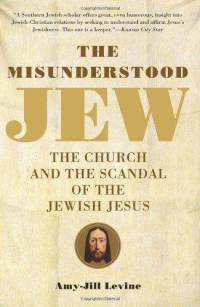
I’ve been reading through for a second time The Misunderstood Jew: The Church and the Scandal of the Jewish Jesus by Amy-Jill Levine. I met her when she came to Memphis last week for a couple of lectures. I’ve benefitted from her work for several years, particularly since she is a Jewish New Testament scholar.Image In an age when there are many misinterpretations of the New Testament because of a lack of understanding of Judaism, and Jews and Christians continue to misunderstand each other, she is a strong provider of aid for both of these problems.

Her book is partly about the Jewishness of Jesus and partly about Jewish-Christian relations. In the former part she devotes a few pages to the Lord’s Prayer. The problem she seeks to address is its “familiarity.” Since most churches recite it often and have done so for so long, Christians tend not to stop and think about what it means.

And what it means in the first place has to do with those who originally received it–not Western Christians, but first-century Palestinian Jews. Not to us, but for us.When placed in a first-century Jewish context, the prayer recovers numerous connotations that make it both more profound and more political. It fosters belief, promotes justice, consoles with future hope, and recognizes that the world is not always how we would want it” (42).

What does Levine uncover about the Lord’s Prayer? Well for one thing, she points out one thing that scholars have known for a while but the public has had trouble learning: while the Aramaic abba may lie behind the Greek translated “father,” it doesn’t mean “daddy.” It simply means “father” as is evident from other Jewish sources and this is should be obvious in light of the fact that every time it occurs it is followed by the Greek translation “pater,” i.e., “father.” Even the scholar who originally proposed “daddy” as a translation for abba believing that it was the word used by little children later retracted his own thesis. But the church really liked the idea of Jesus saying “daddy” so it stuck.

Asides from this, another key detail of Levine’s conclusions on the first line of the Prayer is that just as there is overlap with many key New Testament terms for Jesus and the Roman emperor, such as “son of God,” “savior,” and “lord,” there is another with “father.” This would explain why Jesus specifies “our Father who is in heaven.” Levine writes, “By speaking of the ‘Father in heaven,’ Jesus thus insists that Rome is not the ‘true’ Father” (45).

This hint of an anti-Rome stance is seen more explicitly in what follows “Hallowed by your name,” which is a feature of most Jewish prayers (45). “Your kingdom come” correlates to the common Hebrew expression olam ha-bah, “the age/world to come.” This is distinguished from olam ha-zeh, “this (present) age/world.” Christianity is obscured if one doesn’t grasp this key Jewish idea. Christian eschatology, i.e., the ideas surrounding “end times,” is not identical to the Jewish conception, but it is thoroughly rooted in it. World history is divided into these two stages for Jews, this present age that we are living in which is marked by sin, evil, and injustice. In the coming age, or the future age, this sin, evil, and injustice would be dealt with as God issues his judgment and through is kingdom reigns on earth forever.

Christian eschatology features the same idea of the present evil age and the coming age of righteousness, but it is with Jesus that the coming age has come into the present age. In Christian thought, then, the coming age has been inaugurated even if the present age isn’t over yet. The Christian is waiting for the Messiah to come back; the Jews is waiting for the Messiah to come. So when the Christian prays “your kingdom come, your will be done, on earth as it is in heaven,” the Christian prays for the coming age (or “world”; the word can mean either one or perhaps both) to come in fullness on the earth as it already is in heaven. Christian eschatology, then, is not about people going to heaven but about God coming to earth. This is a thoroughly Jewish, and properly biblical, idea.

It gets really interesting with Levine’s discussion with the next line. “Give us this day our daily bread” as a translation is redundant (47). The word in question, “daily “is epiousion is tricky but probably best translated as having to to do with the next day. The best translation of the line would then be “Give us tomorrow’s bread today,” which makes plenty of sense in a Jewish context. Jewish texts continually associate the olam ha-bah with a banquet. This would be another way of saying “your kingdom come,” or, in Levine’s paraphrase: “Bring about your rule when we can eat at the messianic [kingdom] banquet” (48).

I also like Levine’s preferred rendering of “Lead us not into temptation.” It probably is best as “Do not bring us to the test” (50). “Test” and “tempt” are a couple of meanings of the same Greek word. God is better known in the Old Testament for bringing us to the test instead of leading us straight into temptation. Based on these situations, Levine paraphrases this line: “Do not put us in a situation where we might be tempted to deny our faith or our morals” (50). This would have been an especially  meaningful prayer for first-century Jews and early Christians.

Levine is right to point out that “deliver us from evil” is actually better rendered “deliver us from the evil one.” All scholars I’ve seen favor this translation based on the Greek construction, and in light of the fact that evil is never just a general idea in the New Testament but is always personified.

The latter part the doxology “for thine is the kingdom and the power and the glory forever, amen” is not original to Matthew’s version of the Lord’s Prayer (42). It actually comes from the Didache, originally, an early Christian text that didn’t make it into the canon. 

Why is it in our version of the Lord’s Prayer then? Congregations that recite the Lord’s Prayer typically have kept with church tradition of the past few centuries and recited the version from the KJV. One of the main reasons we have newer translations of the Bible than the KJV is that we now have much greater knowledge of the original wording of the New Testament than they did in the 1600’s. As manuscripts of the biblical documents were copied, changes were introduced and reproduced. It is a compilation of all these manuscripts which produces what we call an eclectic text, i.e. an entire Greek New Testament pieced together from the text of all the known manuscripts, guided by what scholars believe most likely reflects the original wording of the authors. 

This is why this doxology is no longer included in the text of newer translations of the Bible; it is very clear that this is not original to Matthew. It was added to later copies of the Gospel, most likely because of its place in the later tradition which we now find in the Didache.

I remember being in church one Sunday morning and the preacher that day covered the Lord’s Prayer. (This wasn’t a church where we actually prayed it together, so it was good that it at least made it into a sermon.) I’ll never forget this one instance where I knew it was important for the preacher to be educated in order to anticipate people’s questions and to provide them some guidance.

When he got to the end of the Lord’s Prayer, he preached the doxology. He wasn’t working from the KJV, but the New King James Version. The New King James Version may be the most worthless version of the Bible out there. Probably the only good reasons to continue to read from the KJV is the tradition behind it and its beautiful diction. The NKJV is not traditional, loses the beautiful diction since it is an updated version of the KJV—and it retains the obsolete text of the KJV.

A couple sitting in front of me obviously weren’t reading from the KJV or the NKJV. How did I know this? Because they were confused. She looked at his Bible and showed him hers; he looked at hers and showed her his. They didn’t have the doxology in their version of the Lord’s Prayer. And I was completely sympathetic. For people who apparently had no idea about manuscript differences and eclectic texts, it was understandably quite shocking and confusing to listen to a sermon on a text that wasn’t in their Bibles.

It appeared that the preacher didn’t have any knowledge of textual criticism of the New Testament, so he couldn’t anticipate that most of the congregants wouldn’t have that part of the Prayer in their Bibles. And that they would be confused and ready to be taught.

But anyway. It should be clear that this is in no way a “generic” prayer. As Levine says, it actually doesn’t say anything explicitly or uniquely Christian, and in fact it “fits neatly within Jewish piety.” It is “[p]rovocative, directly related to human experience, intimate enough with God to be direct, [and] an ideal prayer for a first-century Jew” (51).


The King Jesus Gospel

This is a long post. But I think if there is a topic I would like to devote too long of a post to, it is this one.

What is the gospel?

This is a question that in the past several years has been increasingly asked by theologians. One would think that this is something that only someone unfamiliar with Christianity would wonder, but some Christian thinkers who are quite familiar with Christianity have realized that what is needed is a fresh reconsideration of just what the gospel is–with as much precise attention to detail as possible, and with as much Scriptural support as is available.

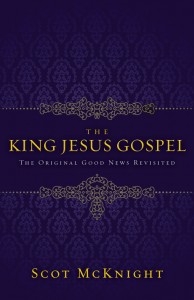
Several books have been written in only the past couple of years that are aimed in this direction. One of them is Scot McKnight’s The King Jesus Gospel: The Original Good News Revisited (Grand Rapids: Zondervan, 2011). McKnight is the Karl A. Olsson professor in religious studies at North Park University in Chicago. He is the author of many books, and I know from what I’ve read of his work that he has a habit of being relevant, witty, easily comprehensible, and, quite simply, correct about what he has to say about the Bible, the church, and related matters.

This book is all of that. What he says here is for the most part exactly what the church needs to come to terms with when it comes to what he hold the gospel to be, and I would rather you read his book then read this blog post if you must make a choice. But you don’t have to. You can read both. : )

Two forewords written by eminent Christian thinkers N.T. Wright and Dallas Willard lead things off. Wright sums up the major point of this book: “that the movement that has long called itself ‘evangelical’ is in fact better labeled ‘soterian.’ That is, we have thought we were talking about ‘the gospel’ when in fact we were concentrating on ‘salvation'” (12).

Now hold on. If you were thinking that the gospel is (or almost) completely about salvation, and you’re willing to consider that this might not be the best way to think about it, then this book is for you. Yep, it’s already clear that this book is making a big claim. A big claim about a big topic that may mess with what you believe to be true and have for a while. Yes, it probably is. But this is hugely important, and McKnight is not actually making any large claim that many other theologians have not been making for some time–it’s just that McKnight’s book is the one of the most accessible products of these scholarly conversations.

Now, don’t freak. This is not about twisting, distorting, exaggerating, neglecting, or completely rejecting what you’ve always held to be true. This is about, as Wright says, about the “full, biblical gospel” (13). This is what McKnight helps us to see.

Some Signs that Things are a Bit Off

In his preface, McKnight discusses the way most of us think of evangelism. Nearly all of his Christian students tell him that the gospel they heard growing up was mainly that they were sinful, but Jesus died to take care of their sin, and so now they could go to heaven.

But something was off. These same students tell McKnight repeatedly that something was lacking. Surely, the say, the gospel of Jesus wants more from us than our one decision to get sins taken care of so we can be ok until we can go to heaven.

It is the message cited above that is responsible for how Christianity got obsessed with people making decisions. The center of it all has been seen as the need for the individual to make the decision to accept Jesus so they can go to heaven. As McKnight is going to show, this is not how it has always been. The original apostles had no decision obsession–they had a disciples obsession (18). Making a decision, or making a disciple. It was the latter that was the mission of those who first announced the gospel to the world.

But put that aside for the moment. How has the decision method been working? McKnight cites the stats: 75% of Americans have made some kind of decision to accept Jesus, but only 25% of Americans go to church regularly (church attendance being the most convenient, albeit somewhat faulty to measure dedicated discipleship) (19). At the most conservative of estimates, the church loses at least 50% of those who make decisions for Christ.

And all of us who have been in evangelical circles even if only for a short time know that this is indeed the way things are. We all have seen people make a decision for Christ and then only a little while later are nowhere to be found within the church body and there is no sign that they are in fact a follower of Christ. This is a significant problem, whether a church acknowledges it or not. (McKnight says there is something “profoundly wrong”  with this [21]). And it’s significant enough that we need to address the question: Is it a problem with the gospel? Or is it a problem with the way we have shared and responded to the gospel?

McKnight, of course, goes with the second option. Our focus on getting people to make decisions (i.e., “accepting Jesus into our hearts”), he says, “appears to distort spiritual formation” (20). But that’s the way the church has always done things! Right? Well, no, and the church has always been and always will be in need of reform.

So, there’s plenty of signs that show us that things are a bit off in the way we share the gospel. But the big question is still, What is the gospel? “For most American Christians, the gospel is about getting my sins forgiven so I can go to heaven when I die” (27). Is this it?

The Gospel is Not About You Being Saved

McKnight knows that what he has to say about all this is going to be hard for many evangelicals to swallow. So he says plainly: “Evangelicalism is a gift to the church and the world” (28). One of this theological system’s most valuable positions is that each must person must make a decision to be saved, as an individual. This is a thoroughly biblical conviction. Way to go, evangelicalism. But as much as evangelicalism is a gift, “it’s far from perfect” (29).

What’s interesting is that the word “evangelical” is directly derived from the Greek euangelion, usually translated “good news,” or “gospel.” The original meaning of the very word “evangelicalism” reflects a commitment to the gospel. Irony is that McKnight’s point is that evangelicals nowadays aren’t very … evangelical. In the sense of being committed to the biblical gospel. A better word to describe evangelicals today is “soterians,” because, we mistake personal salvation with the gospel (29).

This emphasis on personal salvation has led to an obsession with the question “Are you in or out?” (30) Simplifying (and distorting) the gospel down to this one issue is one reason for the huge problem noted above, that so many churches struggle to get the people who have simply made a decision to be discipled as believers of Christ (32). Be honest. We’re almost being audacious to expect people to stick around and go deeper when we’ve presented them with the pressing issue of being in the “in” group instead of the “out” group. We’ve made being “in” as one of the saved people the main and practically only important opportunity available to people, and when they aren’t interested in anything more, we’re surprised??

Maybe the gospel isn’t just about personal salvation. If it is, as I like to say, then we have a ridiculously large Bible. Quite simply, 99.9 % of our Bible is extraneous and unnecessary if the one great truth that we are to gain from it is that we should accept Jesus so we can go to heaven.

Well if the gospel is not about crossing this threshold of personal salvation then what is it about?

It’s about a story. The gospel only makes sense when seen within what is so often ignored in our preaching and teaching: the story of Israel. As McKnight points out (37), what we so often draw from the Old Testament is that Adam and Eve messed things up. Once we got that down, we can speed ahead to the New Testament where we pick out the texts that tell us we can make a decision to solve what Adam and Eve messed up and too often ignore the other ones. There’s a big story here. And a big Bible tells us about it.

This story centers not on personal salvation but on God, the God who created human beings to reign as his image bearers on earth. The story is about the God who works within the human race to reinstate them as image bearers once the original ones failed. And this huge story has a consummation; again, not in your personal salvation, but in the establishment of God’s kingdom on earth, the city of Revelation 21-22, “a flourishing, vibrant, culture-creating, God-honoring, Jesus-centered city” (36).

Yes, personal salvation is in there somewhere. But it’s not the whole story, and it’s not the center. Jesus is. McKnight therefore places the story of Jesus under the larger heading of the story of Israel. It is the story of Jesus that brings the larger story of Israel to its fulfillment. What is important to see is that it is only because the story of Jesus is the completion of Israel’s story that the story of Jesus is salvific. To pluck Jesus out as a generic savior for mankind apart from the entire overarching story to which he has come to us does not work.

It is under the story of Jesus that McKnight places the plan of salvation–i.e., what is often mistaken for the gospel itself. Yes, McKnight’s point is that when we have shared the gospel as the sequence of facts that we are sinful, Jesus has taken care of sin, so that we can trust in him and be saved, is not in fact the gospel but only one corollary of the gospel. And, yes, because of this, “because we preach the Plan of Salvation as the gospel, we are not actually preaching the gospel” (40). I would mend McKnight’s point here a little to add that it’s not that we never preach the gospel, but that we’re not preaching the gospel when we think we are. More on this later. So, maybe this loosening up on the centrality of salvation is shocking to you. Still, McKnight points out, “The good news is that the more we submerge ‘salvation’ into the larger idea ‘gospel,’ the more robust will become our understanding of salvation” (39).

As McKnight launches his biblical case for his argument concerning the true nature of the gospel, he begins with Paul. As it turns out, the best place to look in the New Testament concerning a definition of the word “gospel” comes in one of Paul’s chapters, 1 Corinthians 15. Paul begins, “Now brothers, I want to remind you of the gospel I preached to you, which you received and on which you have taken your stand. By this gospel you are saved, if you hold firmly to the word I preached to you” (vv. 1-2). And what does Paul remind them about the gospel? McKnight summarizes: the message of the gospel is that Christ died, Christ was buried, Christ was raised, and Christ appeared (49).

This is a strange description of the gospel. Where is the part about me and my salvation? Where are the steps I need to take so I can go to heaven? We are helped by realizing once again that a gospel (euangelion) is an announcement, not a plan of salvation. It’s good news (49). For Paul, the gospel, the good news, was about Jesus, in his dying, rising, appearing (50). This is the fulfillment of the story of Israel and all of the promises God made to her (51).

“Because the ‘gospel’ is the Story of Jesus that fulfills, completes, and resolves Israel’s Story, we dare not permit the gospel to collapse into the abstract, de-storified points in the Plan of Salvation” (51).

Here, again, we have a proper emphasis on the story, not on the plan of salvation. And a key aspect of this involves remembering that the story of Jesus “is a complete story, and not just a Good Friday story” (53). McKnight cites on the following page a remark from one of his students about the heavy emphasis placed on all the details of Jesus’s death when sharing the good news in many evangelical churches. No remark about the resurrection, and certainly no sign that Jesus’s life had anything to do with it. Not only is McKnight about to spend a chapter arguing that Jesus himself actually did preach the gospel (because in most definitions of the gospel, this would hardly make sense), but he says at the end of the book that one of the ways we need to work to become more attuned to the biblical idea of the good news is that we need to soak ourselves in the Gospels (153).

While not among the most neglected books of the Bible in our preaching and teaching (I can name many books that are), the Gospels certainly are far under-estimated for their importance. For Christians who think that the only thing that really mattered about Jesus is that he was God incarnate who died on a cross, most of the Gospel narratives simply don’t figure in to our understanding of the good news.

I can testify to this myself.

I remember being greatly confused upon taking on the task of reading the New Testament Gospels myself. A lot of the stuff that Jesus said and did simply didn’t square with what I had been taught over and over was the gospel, the stuff that really mattered. Jesus didn’t say much at all if anything about dying for my sins so I could be saved, so I really didn’t know what to do with what I was reading. Maybe I could’ve just read the passion narratives, and gone back to Paul, who tells us so much about the significance of Jesus’s death–which I knew all about. That would have been a lot more comfortable. But there I was, with four Gospels I didn’t know what to do with. And I know for a fact that’s where a lot of Christians are today. They want to be faithful Bible readers, but (whether they have acknowledged it or not) have no idea what a Gospel is there for, much less four of them. (Of course, the practice of calling these books “Gospels” is misleading because originally it was the singular “Gospel” according to Matthew, and also according to Mark, and so on.)

So what is the gospel then?

Finally, McKnight comes to the point where he makes a positive claim about the actual nature of the true biblical gospel. Having established that it’s not about me but about Jesus, and not about a plan of salvation but about a story, he says that “If I had to sum up the Jesus of the gospel, I would say ‘King Jesus’ [hence the title of the book, The King Jesus Gospel]. Or I would say ‘Jesus is Lord,’ or Jesus is Messiah and Lord'” (56).

This is about as simple as one can get the gospel, just see Romans 1:1-4 for an explicit biblical example of this. And we are also helped out by the comment makes toward the end of this introductory section of his letter in 1:16-17. There Paul refers to the gospel (euangelion), saying that it is the power of God eis soterian, i.e., “unto salvation”–in other words, the gospel leads to salvation for those who believe but is itself not synonymous with salvation.

The trick is that people already assume that they know what “gospel” means, so when they read Paul using that word, they think he means what they mean. McKnight cites N.T. Wright’s comments on this issue: “I am perfectly comfortable with what people normally mean when they say ‘the gospel.’ I just don’t think it is what Paul means” (58). The gospel is not how one is saved, though there is nothing wrong with thinking about how one is saved. The gospel is instead an announcement, the announcement of Jesus’s lordship as the culmination of the story of Israel within the story of the entire world. The problem is that we “turn the story of what God is doing in this world through Israel and Jesus Christ into a story about me and my own personal salvation” (62, emphasis McKnight’s). Then the story of God and his entire world becomes only about having one’s guilt-removed (75). That is absolutely tragic. Yet for many people that’s the essence of Christianity, or at for all practical purposes it is.

It is for this reason that one can properly see how Jesus indeed preached the gospel. If the gospel is the Pauline doctrine of justification by faith, or that Jesus died for your sins so you can go to heaven, then you’ll search far and wide for Jesus saying much about that. But if the gospel is a fulfillment of an expansive story, that the crucified and risen Jesus is the King of Israel and the Lord of the world, then Jesus’s entire mission is a gospel mission.

The Reformation rightfully focused on certain topics for its time, but, again, not to say that the church doesn’t constantly need reform because it does (that is what this post is all about), the Protestant Reformation is over. Justification by faith was exactly what the church needed to focus on during that time in history but what happened as a result of that was that we have put justification by faith at the center of Paul’s theology, much less at the center of what we think of as the gospel, and there it it has remained. The center of Paul’s theology is most assuredly not justification by faith, but Jesus as Messiah. And being “in Christ” is highlighted much more often as the mode of salvation, not justification by faith. After all, it’s being “in Christ” that one must do to be a saved person–not believing that we are justified by faith.

So, justification by faith is one way to describe how Jesus’s story is salvific, but is not itself the gospel. First-century Palestinian Jews, those who first heard Jesus teach would not already have in mind the Pauline articulation of justification by faith. But they would understand the gospel as being about the coming of God’s kingdom; indeed, they were waiting on it.

Here is where it is important to know what it means to say Jesus is Messiah and Lord. As McKnight says, “much of the soterian approach to evangelism (133) today fastens on Jesus as (personal) Savior and dodges Jesus as Messiah and Lord. If there is any pervasive heresy today, it’s right here. Anyone who can preach the gospel and not make Jesus’ exalted lordship the focal point simply isn’t preaching the apostolic gospel” (134).

I think this is the reason why Messiah has largely lost its meaning in contemporary usage. It does not mean Savior, at least not directly, and it does not itself mean that its referent is God. It means “anointed one.” (“Christ” is the Greek translation of this idea.) And one of its primary connotations in early Jewish usage was the idea of the rightful king of Israel. Kings would be anointed, see the story of David in 1 Samuel for example. Israel had been promised that it would have a kingship that would be established forever, but through centuries of exile/foreign rule it did not have such a kingship. The expected and awaited rule of the Messiah, the rightful and proper king of Israel, would be the age of the kingdom of God. This is the time of things being the way they should be, of things being good for Israel, and by extension, of things being good for the world. Jesus is Messiah means Jesus has come to sort out the world and rule here.

The problem is, our personal soteriology is orthodox enough that we know we need a divine Savior, but our theology proper isn’t expansive enough to know that we need a king.

McKnight says a couple pages later: “Remember that the fundamental solution in the gospel is that Jesus is Messiah and Lord; this means that there was a fundamental need for a ruler, a king, and a lord” (137). Indeed, the repeated question in the Bible is not “How am I saved?” but, as McKnight puts it, “‘Who is the rightful Lord of this cosmic temple?'” The answer is, Jesus. That’s the good news. And he redeems and restores the original plan for people to reign on the earth alongside of him. So yes, sin is a problem. But the fix for it is not motivated by a selfish (and need I mention way short-sighted) need to avoid a negative afterlife and have a positive afterlife; it is motivated by the original plan for us to be rulers and priests for God (142).

Here’s another key part of this. When we say that Jesus is Messiah of Israel, and he is also the Lord (or Master) of the world, and what this means is that he reigns, this does not mean that he reigns only in heaven. It doesn’t mean that he reigns only in my heart. It means that he reigns over all. Just as we have misunderstood “Messiah,” “Lord,” and “gospel,” we have misunderstood “kingdom of God.” This does not refer to what we commonly think of as heaven. It refers to God’s very reign itself, and the idea in the New Testament is that in one sense the kingdom of God is coming on earth, and in light of Jesus is in another sense already here. The Christian hope, therefore, is not that we will escape our bodies and the earth to go off to heaven, but that we will be raised to new life in resurrected bodies to go with a renewed creation, i.e. a new heavens and new earth. Other times, if someone realizes that “kingdom of God” refers to the reality of God’s reign and not necessarily to heaven, they still don’t know what to do with it since they still think of heaven as being the goal of our existence. One former pastor of mine almost got it right one time. I could tell he understood the kingdom of God as referring to the reign of God, but the most he could do was say that it’s about the reign of God in our own hearts. What else could he say? He didn’t realize that the kingdom of God is coming on this earth.

McKnight quotes Michael Bird on this: “Nero did not throw Christians to the lions because they confessed that ‘Jesus is the Lord of my heart.’ It was rather because they confessed that ‘Jesus is the Lord of all …'” (144).

I’m well aware that this is lost on many modern Christians, and today’s church has borne the consequences of misinterpreting the Bible and missing this. Among these consequences are the overemphasis on personal salvation, the belief that we’re going off to heaven when we die and putting that at near-central if not central importance, and neglect of the pressing issues facing the world today that Christians are called to address. There are many more. This is a crucially needed paradigm shift, and this book is one example of how this shift is going to happen. But this is at least another whole post in itself.

If you’ve read or skimmed or even skipped down this far, thank you. I know this has been nearly a book in itself, but I strongly recommend you read McKnight’s book. He fleshes out what I have touched on here with much more biblical support and gives a good bit of guidance to us in the right direction.

Basic point. The gospel is not about you being saved but about the lordship of Jesus. Key ramification is not about making a decision to accept Christ to go to heaven but about signing on board to anticipate and herald and bring in the kingdom of God that is coming on earth whether you like it or not. Salvation is involved, but it is not an end in itself. It is a means to everything a human needs to be to  please God and make him known in his kingdom.

It is only in this proper understanding of the word “gospel” that we can appreciate St. Francis of Assisi when he said “Preach the gospel at all times and if necessary use words.” If the gospel is about making a decision to go to heaven, this is incomprehensible. If the gospel is the good news of Jesus being Lord of the world, then Francis has given us a stellar piece of advice.

In the last part of his book, McKnight does give us his own guidelines for making ourselves more familiar in belief and practice with the actual biblical gospel. One is to become well-acquainted with the church calendar. If you go to a church where you hear nothing about Ash Wednesday, Lent, or the season of Pentecost, this will be harder for you to do. But you can do it in your own life. McKnight says, “I know of nothing–other than regular soaking in the Bible–that can ‘gospelize’ our life more than the church calendar” (155).

Again, if you go to church that knows nothing of the church calendar, you probably know nothing of the great creeds of the church either. Look up the Apostolic and Nicene Creeds. Recite them and learn them (156-57).

Many churches today do not properly emphasize the holy sacraments. Baptism and the Eucharist (or Communion, or Lord’s Supper, or Mass) are too often ignored and misunderstood. Study these. Realize why we do them, and what they are for. Each time you witness a baptism, renew your own baptismal vows. Each time you share in the Eucharist, realize why you do so.

McKnight’s last advice is to say the Lord’s Prayer. For some Christians this is common sense. For many others, however, never is the Lord’s Prayer said in communal worship and therefore probably never said in privacy. The Lord’s Prayer is a beautiful prayer thoroughly in touch with the grand story of which we are a part. Jesus gave it to us for a reason. We should pray that his kingdom would come on earth as it is in heaven.

A Theological Introduction to the Old Testament

 I’m reading the second edition of A Theological Introduction to the Old Testament by Bruce C. Birch, Walter Brueggemann, Terence E. Fretheim, and David L. Petersen (Nashville: Abingdon, 2004) as I read through the Old Testament this year. This powerhouse team delivers some very engaging theological points. Here are some I thought I needed to share.Image

On the creation account:

“The command to have dominion (1:28), in which God delegates responsibility for the nonhuman creation in a power-sharing relationship with humans, must be understood in terms of caregiving, not exploitation …

The verb subdue, while capable of more negative senses, here has reference to the earth and its cultivation without parallel in the Hebrew Bible and, more generally, to the becoming of a world that is dynamic, not a static reality ….

This responsibility assigned to the human has not simply to do with maintenance and preservation, but with intracreational development–bringing the world along toward its fullest possible potential.

God intends from the beginning that things not stay just as they were initially created.

God creates not a static state of affairs but a highly dynamic world in which the future lies open to various possibilities, and human beings are given a key role to play in developing them” (44).

To me, this says mainly three things: we are here in physical bodies in a physical world for a reason other than the fact than it’ll just do for the time being; there is much, much more involved in salvation than waiting for the world to come to some sort of end but involves getting on with the things we were actually created for; and this makes no sense apart from the free-will that God affords humans. We make choices that actually matter.

Quoting the scholar Frank Gorman in his comments on Exodus:

“In worship, ‘human beings are called to become participants in the continual renewal and maintenance of the created order.’ What happens in liturgy is for the sake of the world; it is a world-making activity. Worship is a God-given way for the people of God to participate in the re-creation of a new world … The activity of worship may be local, but its concerns and effects are cosmic” (155).

Worship matters this much.

Why Leap Day is Special to Me

On Ash Wednesday, February 25, 2004, I went to go see The Passion of the Christ. I didn’t go because I cared that much about a movie about Jesus. I didn’t go because that’s what church people did. At this time I didn’t go to church and hadn’t for a long time.

I had become friends with a guy in my geometry class. He invited me to go see this because Crosspointe Baptist in Millington, TN was taking teenagers by the busload to go see it. I agreed because it was a chance to hang out with a new friend. Didn’t expect much of anything to happen that was of any significance.

This was back when Peabody Place in downtown Memphis was still open and home to the best movie theater in the region. So there I was in Peabody Place’s jumbo screen theater, watching a movie about Jesus.

I don’t remember what I knew going into it, but I know it didn’t include having the names of all the characters down or being familiar with the finer details of how the story was going to play out. I didn’t read the Bible then.

And then the movie was over. And when it was over, I was a different person. I hadn’t felt that way before and I haven’t felt that way since. I had known something about how Jesus died for humanity and was raised, but I hadn’t ever truly reckoned with the reality of this. Somehow, this film left me feeling like I had been kicked in the stomach because it somehow had shown me that what happened to this utterly perfect and loving man was because of me. I had never considered it before, I guess, but we are totally messed up as a human race.

If you’ve seen the movie, or if you know the story, it has a happy ending. Jesus doesn’t stay dead. He doesn’t remain defeated. But I didn’t feel the ending. I was stuck, fixated on what happened before that and why.

I’ll never forget the bus ride home. I felt like the veil had been lifted, and what was revealed was ugly. Other kids in the bus (those who had been going to church) acted like not much had happened, or not much had changed, and all I could do was sit in silence and try to make sense of what I was feeling and thinking. I felt frustration because I had thought that every single person that watches the movie would have the same exact same experience I had. Why wouldn’t they? But it didn’t take long for me to realize that the world was keeping on the same way, when I had changed.

The next couple days I had a loss of appetite. Trouble sleeping. I couldn’t shake it. I remember at one point sitting down at the computer and rapidly typing out without any organization or paragraph breaks the feelings and thoughts I had as a result of watching the movie. Just a page of thoughts. I passed that out to people when they asked how the movie was. I didn’t know what else to say or what to do.

But there was something unresolved. Maybe I didn’t even know that until the next Sunday morning, when I went to the church that took the teenagers to see the movie because my friend invited me, and I thought it’d be a good thing to do, in light of everything.

I don’t remember the sermon, or who I met that day. I remember two things: what I wore (for some reason), and going forward when the pastor, Steven Flockhart, said I could give my life to Christ and invited me to do so. So that’s what I did. Thinking that it was just the resolution to the problem of how I was feeling, I guess I felt that now that I had that  settled things could now get back to normal.

Little did I know. That day I signed on to my entire life being changed. These years have been the hardest and most challenging of my life, but they have by far been the most victorious and enjoyable at the same time. I love life now. I delight in wonder, I engage my intellect, I appreciate the cool spring breezes like I never had before. I now live with the hope of a loving God bringing all of creation to a renewed and redeemed end. It’s all different, and I sincerely don’t know how I lived any other way. It’s been an amazing journey so far.

That Sunday after I saw the movie was February 29, 2004. So today marks the second time that I have been able to recognize the calendar anniversary when I began to live as a person who, while I continually fail to live up to it faithfully, nonetheless surrenders to the reality of Jesus as the Lord of my life.

And it wasn’t just the movie. The movie was just the way that I got the message, which was all the more appropriate because at the time I had hopes of going into filmmaking. Films were for all practical purposes the god of my life, and if I wasn’t going to sit down and take the biblical witness itself into serious account, God was fine replacing the god of my life with himself by using it to reveal himself.


“Bible” means “books”

Ta biblia. This is the way the early Greek-speaking church referred to what we call the Bible. Translated, it is “the books.” 

ImageThe fact that the Bible is really a collection of books instead of a single book has been obscured since the early days of the church. This is complicated further by the fact that in regards to biblical times we are dealing with a world of scrolls. One scroll could only hold one lengthy book of the Bible (or not even that). Nowadays we have the codex form, which is a bunch of pages stuck together on a spine, pretty standard for the way we do things, but for centuries biblical books were divided up among separate scrolls. 

So when we pick up our bound copies of the Old and New Testaments these days we are not as inclined to view the good Book as an anthology. But that is probably a reasonable way to approach the Scriptures.

Fred B. Craddock, Bandy Distinguished Professor of Preaching and New Testament, Emeritus, at the Candler School of Theology at Emory University, agrees in his book Preaching that the Bible really is an anthology. And the danger of an anthology, as a collection of works by different authors, is that each author’s distinct message, styles, and thoughts tend to be blurred as the reader flips through the pages (116).

Now already we may have a problem. I am well-aware that for many Christians there is no distinct message or style according to each book of the Bible. Indeed, for many Christians the Bible is for all practical purposes not an anthology. For them it is absolutely and only a single book, with a single clear message on every topic, and if you dare talk about differences among the Gospels, for instance, or within the letters or between the books of Samuel and Kings and the Chronicler’s account–then you are misrepresenting the Bible.

However, Craddock points out the truth. Scripture actually does offer “many perspectives” on such topics as “suffering, poverty, eternal life, obedience to civil government, prayer, miracles, or the meaning of Jesus’ death” (117). We don’t respect the Bible by denying its polyvalence and diversity; we in fact do the opposite when we squeeze it into a wholly unified and monolithic mold.

And Craddock believes that the Bible should be taught while respecting it in this way. He asserts, one should no more ask “What does the Bible say?” than one would ask “What does the anthology say?” Maybe this a bit hyperbolic on Craddock’s part, but his point is fair. Much of the time a lesson from the Bible on a given topic consists of a bunch of references assembled without regard for their different contexts, i.e., ignoring the fact that we are dealing with different authors addressing different situations. While he acknowledges that “a general unity does characterize the whole canon,” he says that “the tallying of Scripture references in support of a point hardly qualifies as biblical preaching, nor does it honor the integrity of each writer and the ways in which the community of faith has argued with itself over matters of crucial importance” (116).  

So how does teaching the Bible’s diverse witness go over with the people? Craddock believes that this will not lead to puzzlement; on the contrary, it “will quicken and enrich faith rather than confuse and checkmate at every point” (117). Sounds good to me.

In a book on preaching, of course, Craddock’s main concern is with the pulpit. What does this look like, then?

“In concrete terms, then, the preacher will respect and seek to share with understanding the fact that Ezra-Nehemiah look differently upon foreigners; that the chronicler and the author of Samuel and Kings have their own assessments of David; that Paul’s call to faith and James’ exhortation to works are not addressed to each other or to the same congregation, but to persons needing different corrections to their life-styles. The preacher will permit John to display the many signs Jesus performed as revelations of God without pressing Mark to change his mind about the demand for signs as the quest of an evil and non-trusting generation. The preacher will listen to both Mark and John tell their stories of Jesus healing the blind without getting into the pulpit the next Sunday and telling them as one story. The preacher will celebrate all the visions and miracles with which Luke fills his two volumes, and yet appreciate Paul’s caution about the whole business, and his inability even to speak of his one ecstatic experience of the third heaven. Nor will the preacher who respects the theological integrity of each writer overstaff the Christmas sermon with all of Luke’s poor shepherds plus Matthew’s rich Wise Men from the East. After all, there will be another Sunday and another sermon” (117).

Augustine and the Jews, chapter 1

I introduced the discussion of Augustine and the Jews: A Christian Defense of Jews and Judaism by Paula Fredriksen here.

Part I: The Legacy of Alexander, Chapter 1: Gods and their Humans

“The roots of Christianity run deep in Judaism. And the roots of anti-Judaism run deep in Christianity.” Thus begins Fredriksen’s introduction to the first part of her book. To flesh out in fullness the relationship of Augustine to these two facts, Fredriksen provides the scope to her book as she begins her first chapter: “Understanding the traditions of Christian anti-Judaism, in order to see how Augustine’s ideas on Jews and Judaism ultimately challenged them, begins with an understanding of the world in the wake of Alexander the Great” (1).

But first, back to Augustine. Contrary to popular belief, Fredriksen notes that Augustine’s father was Christian, though not baptized until the end of his life. Usually it is said that Augustine’s father was a pagan. His mother was a “fervent believer” (3).

With a father who was pagan or not, Augustine definitely grew up in a thoroughly pagan world in North Africa in the middle of the 4th century. Fredriksen highlights how he would’ve learned much about classical gods such as Juno, Zeus, and Athena in his formal education.

Turns out, the nature of this pagan education is quite pertinent to the matter at hand: “How did Augustine learn to read and to think with pagan literature, and how did this education ultimately affect his reading of the Bible and this his interpretation of Judaism?” (3)

This question is answered by looking at the world that gave rise to this form of education, i.e., the world of Alexander the Great (3).

Nearly seven centuries before Augustine, Alexander conquered a vast stretch of the eastern world. The international culture he instilled alongside his reign is known as Hellenism, a system of Greek thought, language, religion/politics, etc: “the West’s first great experience of globalization” (4).

It is this very system that gave rise to the Septuagint, the Greek translation of the Hebrew Old Testament which the New Testament writers most often quote and allude to, and apart from which it would be hard to imagine how Christianity could have gotten off the ground as a largely Gentile (i.e., Greek-speaking) movement.

Hellenism brought many different types of people together, and different peoples had their different gods. These gods were therefore brought together into closer and more common contact (5-6).

Fredriksen describes the ancient world populated by two populations: gods and humans. These gods lived in heaven much of the time, yes, but they also lived on the earth, localizing around holy sites whether natural or manmade. A primary manmade example being a temple. A god dwells in his temple, and Fredriksen directs us to Matthew 23:21 as a handy Jewish example of this view (6).

In or around this holy site of the god’s presence would that god meet with his people, and often they would “eat” together. Satisfying the god in proper cultic piety, the worshiper would bring an animal, cereals, wine, etc. before the god.

But this was not the only way gods were located within a certain sphere; they were also located among their peoples. In other words, a person would receive a certain god by being born in a certain family. “In antiquity, gods ran in the blood” (7).

In talking about all this ancient stuff, Fredriksen notes her hesitance to refer to it as “religion.” She uses that word in scare quotes because of the way that the typical reader of her book, the modern Westerner, would understand it. For our culture, Fredriksen writes, “religion is a detachable aspect of individual identity. Largely personal or private, modern religion seems first of all a question of beliefs. And beliefs themselves often relate to individual psychological states, the sincerity of commitment or conviction or inner disposition of the believer” (7).

She continues: “In the ancient Mediterranean, by contrast, the closest social analogue to our concept of religion would be cult, those protocols and practices whereby humans enacted their respect for and devotion to the deity, thereby securing heaven’s good will. Cult focused on deeds. It was communal” (7).

Probably without even meaning to, Fredriksen has brought up an important lesson for contemporary Christians in the Western world. Many of us think of religion as being made up those things that we believe in our privacy, or worse, those things that we may somehow believe but don’t affect to any respectable degree what we do out in the world. Now, modern religion (most of the time) has no cultic aspect to it–I don’t think people are out there sacrificing animals. But, I think that we mistake religion, and most importantly for me and my context, Christianity, as being private. Personal yes, but private, no. Religion has historically not been something that you do by yourself. It is not just belief, it is deed. It is not just private, it is communal.

This communal aspect doesn’t just reflect how gods would be worshiped publicly, which they would’ve been, but also how, as she says, “gods ran in the blood.” Gods were then ethnic, just as their respective peoples were ethnic. Entire cities, then, whose citizens were descendants of a certain god could benefit in their relationships with other cities from “invoking newly discovered bonds through ancient divine-human relationship” (9).

Fredriksen contrasts this idea of being offspring of gods that was common among pagans with the Jewish God, who in no way coupled with humans. Still, “He had children nonetheless.” Those called children of the Jewish God are those who are intimate with him in a completely non-sexual relationship. Still, the Jewish God ran in the blood. So much so that his people composed an entire race known as the Jews (9-10).

In this ancient world, therefore, just as all sorts of different people ran into each other at different times, so did their gods. However, don’t make the mistake of seeing the nature of their interaction as “tolerance,” Fredriksen warns. It’s not mere tolerance; it’s pluralism. Related to this point is a vital one for moderns to face if they are to understand the religious world of antiquity: “the existence or nonexistence of the gods of outsiders … was not at issue. Ancient peoples generally assumed that various gods existed, just as their humans did” (10).

If I remember right, it was Larry Hurtado (a Christian New Testament scholar at Edinburgh) said at a SBL conference session on monotheism I attended that ancients knew when gods existed if there people sacrificing to them. Not only does this underline the basic importance of the cultic aspect of ancient religion that Fredriksen highlights, it also shows that existence of gods in antiquity was generally assumed.

Now this is not now modern Westerners are accustomed to thinking about the issue of the existence of gods, and it rightfully comes as a shock to those who realize for the first time the distance that is in place between ourselves and the ancients in this regard. More shock comes when we see it in the Bible.

“Who is like you, O Lord, among the gods?” praises Moses in Exodus 15:11. God commands “You shall have no other gods before me,” in Exodus 20:3. Fredriksen cites these texts and others like them such as Micah 4:5 as evidence that Israel accepted the existence of other gods. This came to them as part of their culture. It’s simply the way people thought back then. Though Fredriksen believes this belief persists well into the New Testament period and can be seen even in the writings of Paul, I discern a transition period where Israel began to believe that other gods weren’t just lower than YHWH their God–they didn’t even exist. I differ with her on this point but I have no problem granting that the ancient Israelites believed that other gods existed. I think God speaks with us in light of our situations, be they historical or cultural or religious. His revelation is unveiled progressively, and so I don’t see any reason why we should reject the idea that God would grant for the sake of argument, as it were, that other gods existed in order to tell his people that they shouldn’t worship them. Whether it was existing gods or non-existing gods or tree fungus–Israel was to worship YHWH their God who brought them out of Egypt and him alone.

So back to the idea of pluralism. This was the nature of ancient religion. And ancient civilization reflects such a religious idea. Whereas moderns tend to think of cities as areas of big secular space, it was exactly the opposite in antiquity. Ancient Mediterranean cities were, Fredriksen notes, “religious institutions” (13). Displays of religious devotion–remember, this means sacrifice–were public and demonstrated one’s responsibility to one’s city. Happy gods = prosperous cities. If there was horrific drought, or disastrous floods, this meant the gods were not happy and were therefore not being treated properly by the citizens (14).

Another aspect to this civil-religious-public-cult thing of the ancient world, is the cult of the ruler which was introduced by Alexander and perfected by Rome in its emperor cult. The Roman emperors were seen as heaven’s special divine agents on earth. When they died, they were translated to heaven (in antiquity not everyone went to heaven after death) where they continued to serve the empire (14). The cultic treatment they received helped to bind together not only the citizens of the empire but heaven and earth as well (15).

 Next chapter: “Gods and the One God.”

Salvation is like a Baseball Bat

Here’s Richard Bauckham being onto something yet again in his book on Revelation (The Theology of the Book of Revelation. New Testament Theology. Cambridge: Cambridge University Press, 1993).

Commenting on the new revelation of the scroll which only the Lamb is worthy to open (5:1-9) Bauckham writes:

“The content of the scroll is not that faithful Christians are to suffer martyrdom or that their martyrdom will be their victory: these things are already clear in 6:9-11; 7:9-14.”

Indeed, Bauckham points out that rather:

“The new revelation is that their faithful witness and death is to be instrumental in the conversion of the nations of the world. Their victory is not simply their own salvation from a world doomed to judgment, as might appear from chapter 7, but the salvation of the nations.”

Ahh. In case you need further clarification, Bauckham continues:

“God’s kingdom is to come not simply by saving an elect people who acknowledge his rule from a rebellious world over which his kingdom prevails merely by extinguishing the rebels.”

(How often is this the way the story is told?) Bauckham provides the appropriate, (i.e., biblical) alternative:

“It is to come as the sacrificial witness of the elect people who already acknowledge God’s rule brings the rebellious nations also to acknowledge his rule. The people of God have been redeemed from all the nations (5:9; emphasis from Bauckham) in order to bear prophetic witness to all the nations (11:3-13; his emphasis again)” (84).

In you, yes. God wishes to save you because he wants to work his love and grace and mercy in you. But a coin has two sides–God wishes to save you because he wants to work his love and grace and mercy through you as well.

Many of us have the habit of not articulating this other side of the coin so well when we’re talking about what it means to be a Christian. We emphasize the matter of personal salvation, which is important, as a resolution to a legitimate problem and a satisfaction of an urgent need, but we don’t emphasize strongly enough (or mention at all) that this is about signing on board to be the way God in turn saves the entire world. 

Facing this problem head on, another brilliant British New Testament scholar, N.T. Wright, in his Justification: God’s Plan and Paul’s Vision (Downers Grove: InterVarsity, 2009), makes this comparison:

“The theological equivalent of supposing that the sun goes round the earth is the belief that the whole of Christian truth is all about me and my salvation” (23; emphasis Wright’s).

In other words, believing “that the whole of Christian truth is all about me and my salvation” is self-centered, naive, short-sighted, and .. wrong.

Wright says on the next page:

“God is rescuing [saving(!)] us from the shipwreck of the world, not so that we can sit back and put our feet up in his company, but so that we can be part of his plan to remake the world” (24).

Here’s an illustration of this point that Wright provides in another book, my single favorite book, Surprised by Hope: Rethinking Heaven, the Resurrection, and the MIssion of the Church (New York: HarperOne, 2008):

“To suppose that we are saved, as it were, for our own private benefit, for the restoration of our own relationship with God (vital though that is!), and for our eventual homecoming and peace in heaven (misleading though that is!) is like a boy being given a baseball bat as a present and insisting that since it belongs to him, he must always and only play with it in Imageprivate. But of course you can only do what you’re meant to do with a baseball bat when you’re playing with other people. And salvation only does what it’s meant to do when those who have been saved, are being saved, and will one day fully be saved realize that they are saved not as souls but as wholes and not for themselves alone but what for God now longs to do through them” (199-200).

That’ll preach.

Resurrection kata Richard Bauckham

Sometimes scholars are so good they’re worth just quoting and letting that be it. It certainly makes my job easier.Image

The following is from Richard Bauckham’s excellent little book The Theology of the Book of Revelation in the New Testament Theology series published by Cambridge University Press

“The understanding of God as Creator was not only integral to Jewish and Christian monotheism; it was also essential to the development of Jewish and Christian eschatology.

If God was the transcendent source of all things, he could also be the source of quite new possibilities for his creation in the future. Creation is not confined for ever to its own immanent possibilities. It is open to the fresh creative possibilities of its Creator. 

This is how the hope of resurrection was possible. 

The Jewish hope of resurrection was not based on belief in the inherent capacity of human nature to survive death (although some kind of survival was often assumed). It was fundamentally a form of trust in God the Creator, who, as he gave the life that ends in death, can also give life back to the dead. 

More than that, he can give new life–eschatologically new life raised forever beyond the threat of death. Whereas mortal life, cut off from its source, ends in death, God can give new life which is so united to his own eternal life that it can share his own eternity” (48-9).